|
|||||||||||
|
|
|||||||||||
|
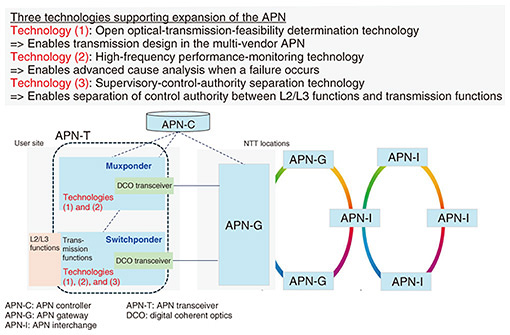
Feature Articles: Technology Development Trends of the IOWN 2.0 Era—From Communications to Computing Vol. 24, No. 4, pp. 38–45, Apr. 2026. https://doi.org/10.53829/ntr202604fa4 Trends in Research and Development of the Latest Transponder Technology Supporting Expansion of APN DomainsAbstractIn the IOWN (Innovative Optical and Wireless Network) 2.0 era, the further expansion of the APN (All-Photonics Network) will require three technologies: open optical-transmission-feasibility determination technology that enables transmission design for multi-vendor networks, high-frequency performance-monitoring technology that enables advanced fault-cause analysis, and supervisory-control-authority separation technology to enable the integration of transmission equipment and routers for installation at user sites. These three technologies are introduced in this article. Keywords: All-Photonics Network, transponder, open optical interface  1. Challenges and initiatives for expanding the APNThe All-Photonics Network (APN) [1] of the Innovative Optical and Wireless Network (IOWN) 2.0 era is expected to be used in a variety of fields, including broadcasting, construction, and manufacturing, and to implement the APN, it is becoming increasingly important to expand the current networks. At the core of the APN, transponders accommodate client signals in the APN, but expanding the APN faces three major challenges. The first challenge concerns transmission design. Multi-vendor solutions are important in terms of avoiding vendor lock-in and optimizing costs. To achieve multi-vendor solutions for transmission equipment, it is not enough simply to implement a standard-compliant interface [2]; instead, it is necessary to devise a system that can determine in advance—from the design stage—whether transmission between equipment from different vendors is possible. The second challenge concerns failure-cause analysis. As the APN expands, networks will increasingly consist of a mix of equipment from multiple vendors. In a network constructed by a single vendor, it is relatively easy to predict expected failure patterns and identify the cause of failures. However, in multi-vendor environments, unexpected failures are more likely to occur, so failure-cause analysis is significantly more difficult. Such failure-cause analysis requires advanced analytical techniques that analyze transponder log information in detail, and that advanced analysis requires frequent monitoring of the optical-signal status. In regard to the conventional interval for monitoring transponders, however, it is challenging to obtain sufficient information for such advanced analysis. The third challenge is the installation of transponders at user sites. Regarding the APN, transponders for accommodating client signals had mainly been installed at NTT locations. However, to make wider use of the APN, it is necessary to be able to connect to the APN from locations close to the user, so it is necessary to install transponders at user sites. Installing transponders in addition to switches and routers at user sites increases the space required for equipment and complicates maintenance and operation. To address this issue, we are investigating a configuration that introduces a “switchponder,” which integrates the layer 2/layer 3 (L2/L3) functions of switches and routers with the transmission functions of a transponder. Although APN service providers want to monitor and control transmission functions, they want users to manage L2/L3 functions. It is thus necessary to implement, within a single switchponder, a mechanism for separating the authority for monitoring and control. The technologies that will solve these three challenges are respectively open optical-transmission-feasibility determination technology, high-frequency performance-monitoring technology, and supervisory-control-authority separation technology (Fig. 1).
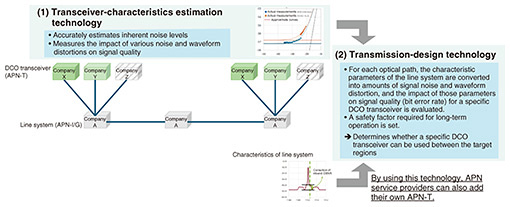
In addition to establishing these technologies, NTT Network Innovation Center (NIC) is also developing an open converged transponder (OCT) that applies these technologies. Two types of OCTs are envisioned: muxponders, which have the transmission function of multiplexing client signals and accommodating them in an APN, and switchponders, which provide L2/L3 functions in addition to the transmission function. OCTs are positioned as transponders that can flexibly accommodate the diverse use cases of the IOWN 2.0 era. 2. Technologies related to muxponders and switchpondersBoth muxponders and switchponders have open interfaces, so they are expected to enable connection with APN interchanges/gateways (APN-Is/Gs) from different vendors. In addition to implementing interfaces that comply with standards, technology to determine whether optical connection is possible at the desktop stage of designing a transmission network is required. As the APN becomes more multi-vendor and increases its coverage, it has become a concern that intermittent faults that cannot be adequately monitored and analyzed using conventional supervisory control will become more apparent, so more advanced monitoring technology is required. These technologies are introduced in the following subsections. 2.1 Open optical-transmission-feasibility determination technologyWhen an APN is being configured, a mechanism to determine in advance whether optical signals can be transmitted from point A to point B without any problems is required. The mechanism that meets that requirement is called optical-transmission-feasibility determination. If devices are connected without determining this feasibility, signals may degrade more than expected while propagating along the communication path in a manner that makes communication impossible or unstable. Conventional optical-transmission-feasibility determination systems have a significant limitation, e.g., the detailed characteristics of the line system (APN-Is/Gs) and transceivers (APN-Ts) are managed internally by the system vendor, and only equipment that the vendor approved as “OK for a certain combination” can be used. Even if it is necessary to change to a transceiver or transponder made by another vendor, the user is effectively left with no freedom of choice, because if a certain combination of APN-Is/Gs and APN-T was not intended by the vendor, it would be impossible to determine whether transmission was possible. This limitation has posed a major challenge for operators wanting to create a multi-vendor network. The idea behind addressing this limitation is open optical-transmission-feasibility determination technology (Fig. 2). This technology can determine transmission feasibility by using common rules and parameters, even if the equipment that makes up the network comes from multiple vendors. The key point is that it can be evaluated openly without relying on optical characteristics that are managed only within a specific vendor.
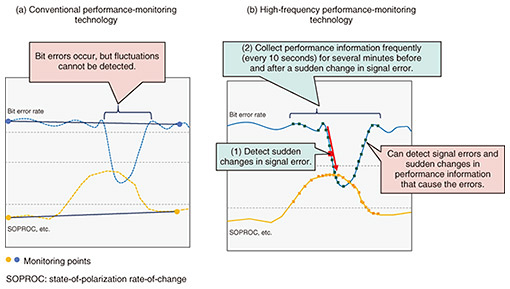
Open optical-transmission-feasibility determination technology consists of two major elemental technologies. The first elemental technology estimates the characteristics of transceivers (APN-Ts). The amount of noise inherent in each transceiver is accurately estimated, and the effect of various noise and waveform distortions on the quality of actual optical signals is measured and modeled. It thus becomes possible, for example, to numerically determine the maximum noise level that will keep the bit error rate within an acceptable range. The second elemental technology (for transmission design) determines whether transmission is possible from estimated transceiver characteristics and line-system characteristics. For each optical path between certain base stations, the parameters of the line system are converted into amounts of signal noise and waveform distortion, and whether the final signal quality (such as bit error rate) is within the acceptable range for the specific in-use transceiver is calculated. To account for equipment degradation and environmental changes over long-term operation, a safety factor (margin) is added to the calculation. On the basis of this safety factor, it is possible to determine whether a candidate APN-T can be used for transmission between specific regions. Open optical-transmission-feasibility determination technology can therefore determine the feasibility of an optical path independently of the vendor by dividing the process into two steps: (i) estimating transceiver characteristics and (ii) creating transmission design on the basis of the characteristics of the transceiver and line system. Operators can thus freely combine equipment from multiple vendors and design and operate stable optical transmission networks. 2.2 High-frequency performance-monitoring technologyAs transponders become more multi-vendor and the APN becomes broader, the risk of intermittent failures, errors that occur for momentarily then disappear, increase. It is difficult to identify the cause of intermittent failures, and there is concern that they will increase on-site maintenance work. With the conventional monitoring technology, the status of the optical signals sent and received by an APN-T is recorded every 15 minutes. This technology is sufficient to understand long-term trends such as aging degradation, but temporary failures that occur for only a few seconds to several dozen seconds often do not show up in the 15-minute snapshot. Therefore, the risk of silent failures, an error occurs momentarily but is not registered in the log, increases. High-frequency performance-monitoring technology was developed to solve this problem (Fig. 3). This technology monitors the status of the APN-T in short intervals, such as every 10 seconds, and when the optical-signal status significantly changes, it intensively records the data before and after that change. It thus becomes possible to track down the signs and causes of failures more accurately.
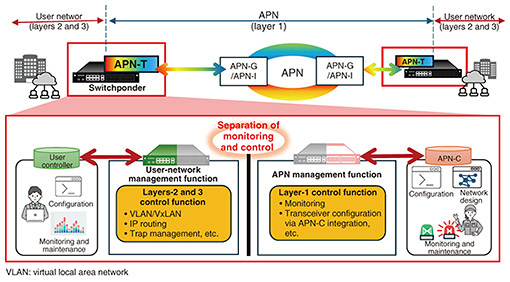
Simply trying to log the APN-T status every 10 seconds poses challenges for conventional logging systems. For example, compared with saving information every 15 minutes, saving every 10 seconds increases the amount of data by approximately 150 times, thus requires large-capacity storage. For our new logging system, we have thus devised a two-tiered storage structure composed of a primary storage area and secondary storage area. The primary storage area stores the most-recent few minutes of information only. It acts like a temporary buffer in which only the most-recent data are always retained and older data are overwritten. If a significant change in the optical-signal status (possibly indicating a malfunction or abnormality) is detected during monitoring, the data for the last few minutes (stored in the primary storage area) are copied to the secondary storage area. Data for several minutes after the optical-signal change are also saved in the secondary storage area. Therefore, both the “status before the abnormality occurred” and the “status after the abnormality occurred” can be obtained in the form of fine-grained logs (covering approximately every 10 seconds). The key to this logging system is that instead of constantly recording large volumes of logs, a detailed record is only kept before and after occurrence of a suspicious change. This process allows for efficient accumulation of high-resolution monitoring data without unnecessarily increasing storage amount. These detailed logs left in the secondary storage area are sent to an APN-C, a higher-level control device. An APN-C uses this highly accurate log information to analyze the cause of the failure and more precisely isolate which device or section is at fault. Even in the event of a silent failure, the amount of on-site work required to isolate the failure cause (such as manual investigation and replacement work) can be reduced in a manner that leads to reduced maintenance operations and improved network reliability. 3. Switchponder-related technologiesNIC is developing a switchponder that makes it possible to provide a variety of APN services. The term “switchponder” is a combination of “switch,” which forwards packets via Ethernet/Internet Protocol (IP), and “transponder,” which converts Ethernet/IP-based electrical signals into optical signals for transmission. A switchponder is a network device that combines the function of a transceiver (APN-T), which serves as the termination point of the optical path in the APN, and the function of forwarding packets via Ethernet/IP [3] (Fig. 4).
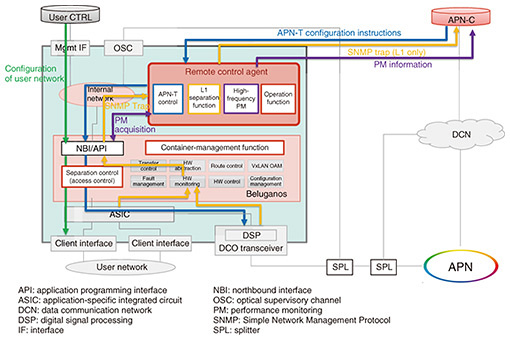
Advances in digital coherent optical technology have led to smaller, more-energy-efficient, and higher-performance transceivers, which can be directly installed in switches and routers as pluggable transceivers. This technology, which integrates dense-wavelength-division multiplexing (DWDM) functionality in routers and switches and connects them directly to an optical network, is called “IP over DWDM.” While a transponder that converts between optical and electrical signals was previously required between routers and transmission equipment, IP over DWDM enables routers and switches to be connected directly to the optical network, thus potentially reducing equipment costs and saving space. Users can also easily connect to the APN by installing transceivers (provided by NTT) in their own routers and switches. One of the reasons that IP over DWDM has attracted attention is the emergence of the OpenZR+ standard. OpenZR+ is a multi-source agreement that integrates the 400ZR standard defined by the Open Internetworking Forum with the open ROADM (reconfigurable optical add/drop multiplexer) functionality, which is widely adopted in optical transmission equipment. It is supported by form factors commonly used in routers and switches, such as QSFP-DD (quad small form-factor pluggable double density) and OSFP (octal small form factor pluggable), and offers flexible data rates from 100 to 400G (providing a reach of up to 600 km for metro-regional applications) and high power efficiency. Currently, 800G OpenZR+-compliant transceivers are available, and hyperscalers and telecommunications carriers are looking to it as a standard that will enable high-capacity, long-distance connections for accommodating the rapid growth in artificial intelligence and cloud traffic. NIC is developing an OCT switchponder that uses a white-box switch; its in-house network operating system (OS), Beluganos [4]; and a 400G OpenZR+-compliant transceiver. Like the OCT muxponder, the OCT switchponder is equipped with functions for open optical-transmission-feasibility determination and high-frequency performance monitoring. It also has a function for separating control authority between the management of Ethernet/IP layers 2 and 3 and the management of APN-T layer 1, so they can be controlled independently. 3.1 Supervisory-control-authority separation technologySupervisory-control-authority separation technology is a function that primarily separates the scope of control over configuration and monitoring of network devices between users and APN service providers (Fig. 5). In conventional optical transmission services, service providers are responsible for optical-path design and operation management in a way that ensures quality. This function enables transceivers to be configured and managed automatically from a controller (APN-C) owned by the APN service provider.
This function is implemented by the network configuration access and control model (NACM) and a remote control agent (RCA), a container application running on Kubernetes on the switchponder’s host OS. NACM is an access control model for NETCONF/RESTCONF, the control interface for network devices, and makes it possible to restrict the types of operations (read and write) available to each user and the data they can access. It thus becomes possible to separate the range of functions accessed by users and APN service providers. The RCA acts as an intermediary between the interface between the host OS and controller. For routers and switches that control layers 2 and 3 and transmission devices that control layer 1, the required functions and device-management data models differ. By converting the data model used for transceiver control and monitoring by the RCA, OCT switchponders can be controlled and managed via a common interface specification for OCT muxponders and other transmission devices. The RCA also incorporates essential management functions for transmission equipment, such as high-frequency performance monitoring and alarm notification. By implementing it as a container application, it can be added as an add-on as needed for purposes such as APN services. 4. Future developmentsThree technologies that support the expansion of APN coverage—open optical-transmission-feasibility determination technology, high-frequency performance-monitoring technology, and supervisory-control-authority separation technology—were introduced in this article. NIC is working to commercialize our OCT by using these three technologies, and in a field trial conducted in October 2025 [5], we demonstrated automatic restoration switching and on-demand increase in speed in a commercial environment linking an OCT switchponder with an APN-C. We will continue to establish these technologies and commercialize transmission equipment while aiming to develop the APN to accommodate the diversifying next-generation use cases. References
|
|||||||||||