|
|||
|
|
|||
|
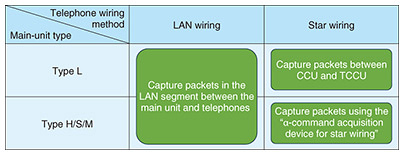
Practical Field Information about Telecommunication Technologies Vol. 24, No. 5, pp. 58–62, May 2026. https://doi.org/10.53829/ntr202605pf1 Case Study on Using the α-Command Analysis Support Tool for Handling Problems Occurring during Use of Business Phone SystemsAbstractMany problems reported by customers regarding NTT’s “α Series” business phone systems are caused by an unintended operation, due to incorrect operation of telephone terminals, or unexpected behavior due to constrains concerning equipment specifications. Identifying the status of telephone operation when such problems occur is difficult since the control commands (α-commands) exchanged between the α-Series main unit and telephone terminals is not recorded in the system log. This article introduces a method for analyzing α-commands using the α-command analysis support tool and two example cases of its use. Keywords: business phone system, packet capture, α-command analysis support tool  1. Cases of problems with business phone systemsAt NTT EAST’s Technical Assistance and Support Center (TASC), we handle daily problems related to the services and products provided by NTT EAST and NTT WEST. Among the communication equipment installed in customer premises, the most-reported problems with NTT’s “α Series” business phone systems include inability to make or answer calls and sudden call disconnection. In many of these cases, the cause of the problems is not a malfunction of the communication equipment, rather unintended operation by the customer (due to incorrect operation of the telephone) or unexpected behavior due to specification limitations. Analyzing the control commands (α-commands) exchanged between the α-Series main unit and telephone terminals is effective for resolving problems arising from such operational errors. A method for analyzing α-commands using the α-command analysis support tool developed by TASC and two examples of its use (use cases) are introduced in this article. 2. Analysis method using the α-command analysis support tool2.1 What is an α-command?As control commands for business phone systems, α-commands are exchanged between the α-Series main unit and telephone terminals. α-commands control operations such as operating a telephone, displaying information, and switching display lights on and off. However, operations of this kind are not recorded in the system log, so it is impossible to confirm the status of telephone operation when a problem occurs. To address this issue, TASC developed the α-command analysis support tool that can visualize α-commands from packet data and use that information to resolve problems caused by unintended operations due to incorrect telephone operation or equipment-specification constraints. 2.2 Methods for obtaining the data required for analysisTo analyze α-commands with this tool, it is necessary to acquire packet data during communication using α-commands; however, the acquisition method used depends on the main-unit type. The α Series of business phone systems (called SmartNetcommunity αZX) are available in four types (H, S, M, and L), which are chosen according to communication capacity. The differences in places that α-commands are acquired are listed in Table 1. Regarding telephones with local area network (LAN) wiring, α-commands are acquired by capturing packets in the LAN segment connecting telephones and the main unit. Regarding telephones with star wiring, Type L enables α-commands to be acquired by capturing packets in the LAN segment connecting the central control unit (CCU) and time-division multiplexing CCU (TCCU). Regarding Types H, S, and M, the segment connecting the telephones and main unit do not have a LAN segment, so data are acquired using the “α-command acquisition device for star wiring” developed by TASC [1].
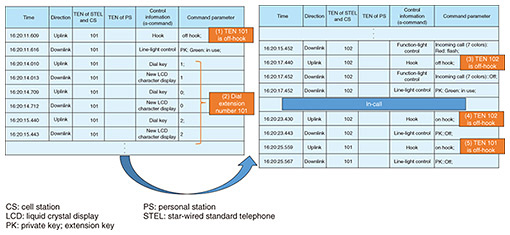
2.3 Examples of α-commandsExamples of α-commands visualized using the α-command analysis support tool are listed in Table 2. This table shows the operations when an internal call is made between two key telephones—“TEN (terminal equipment number) 101/Extension number 101” and “TEN 102/Extension number 102”—connected to an αZX Type S main unit. The specific operation flow follows five steps: (1) TEN 101 goes off-hook; (2) the number of TEN 102 (the destination) is pressed; (3) TEN 102 goes off-hook and the call is established; (4) TEN 102 goes on-hook and the call ends; and (5) TEN 101 also goes on-hook. By using the α-command analysis support tool, it is thus possible to understand the specific operations carried out by customers on their telephones when a problem occurs.
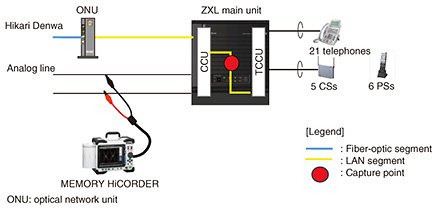
3. Example cases of problem analysisTwo cases in which problems reported by customers were analyzed with the α-command analysis support tool are introduced in the following subsections. 3.1 Case 1: Analysis of a problem caused by incorrect operationAfter upgrading from another company’s business phone system to the SmartNetcommunity αZX Type L, the customer encountered the same problem several times a month: the line key (LK) assigned to the analog line lights up in red and the line becomes unusable. The configuration of the customer’s equipment is shown in Fig. 1.
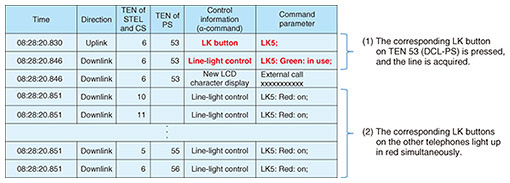
To identify the cause of this problem, we verified telephone operations through packet capture and α-command analysis and confirmed the usage status and analog sequence by measuring the voltage on the analog line using a MEMORY HiCORDER. The results visualized with the α-command analysis support tool are listed in Table 3.
When the main unit accepted the operation of pressing the LK5 button on digital cordless telephone personal station (DCL-PS) TEN 53, the status of the analog line was changed to “in use” (green light) by TEN 53 [(1) in Table 3], and the ZXL main unit sent an instruction to other telephones, such as star-wired standard telephone (STEL) TEN 10, to change the status to “unable to connect” (red light), which caused the LK5 button of all other telephones to light up in red at the same time [(2) in Table 3]. When we checked the analog sequence before the problem occurred, we found that the “off-hook” state had continued immediately after the LK button on TEN 53 (DCL-PS) was pressed. These results confirmed that pressing the LK button on TEN 53 (DCL-PS) caused the LK buttons on other telephones to light up in red during normal operation. Analysis of the α-commands clarified on which telephone the LK button was pressed, so when the user of the telephone in question was interviewed, it was found that the telephone is usually carried in a pocket. We thus surmised that it is highly likely that the LK button on the telephone was pressed unintentionally while the telephone was being carried. In this case, the α-command analysis revealed that the problem was caused by a customer operating the telephone incorrectly. The problem was resolved by reviewing the telephone-operation method and changing the LK settings according to the intended use. 3.2 Case 2: Analysis of a problem caused by a specification constraintThe problem that occurred in this case was an external call being disconnected mid-call on a DCL-PS connected to a SmartNetcommunity αZX Type L main unit. The configuration of the customer’s equipment is shown in Fig. 2.
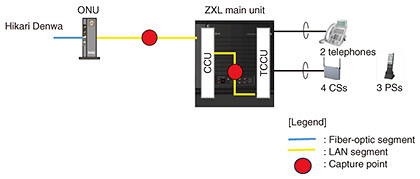
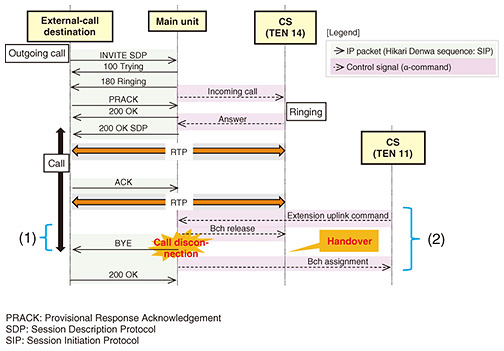
To confirm the entire call process (from receiving an INVITE message and the telephone ringing to disconnect the call), we used the α-command analysis support tool and captured packets between the optical network unit (ONU) and main unit. The communication content at the time the problem occurred is shown sequentially in Fig. 3.
The analysis results confirmed the following sequence: (1) A “Bch release” (Bch: bearer channel) was sent from the main unit to the cell station (CS) linked to the DCL-PS currently in a call (TEN 14), a call termination signal (BYE) was subsequently sent from the main unit to the network, and the call being made was terminated accordingly. (2) Immediately before the Bch release was sent, an “extension uplink command” was sent from another CS (TEN 11). After the Bch release was sent to CS (TEN 14), the Bch was assigned to CS (TEN 11), confirming that the handover operation occurred. This sequence of operations revealed that the problem was caused by the call being disconnected during the handover process. When we checked the customer’s settings while referencing the installation and maintenance manual, we discovered that the “automatic call recording” function was enabled. Since (according to the specifications) the handover function and automatic-call-recording function cannot be used simultaneously, we concluded that the presence of both functions was the cause of the problem. This case involved α-command analysis and visualization of the Hikari Denwa sequence, which revealed that the problem was due to a specification constraint. The problem was solved by reviewing the telephone settings and adjusting them to better suit the customer’s operational environment. 4. ConclusionAs described above, it can be difficult to identify—by using only the main unit’s logs—the cause of problems arising from either unintended operations of telephone terminals by the customer or constrains concerning equipment specifications. However, using the α-command analysis support tool makes it possible to visualize the specific operation of the telephones, and by combining the visualization results with information such as analog sequences and Hikari Denwa sequences, it is possible to identify the cause of the problem and take countermeasures to resolve it. TASC will continue contributing to solving on-site problems through technical support for those involved in the maintenance and operation of telecommunication facilities. Reference
|
|||