|
|||||||
|
|
|||||||
|
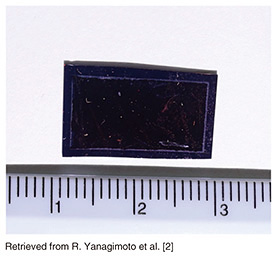
Feature Articles: NTT Research 2.0 Programmable Photonics—Writing Functions onto Blank Devices with LightAbstractWe introduce a novel approach to programmable photonics that enables the real-time writing of optical device functions (programs) using light. We created a device that is a blank slate; it has no structure and no functionality at the time of fabrication. Yet by illuminating its surface with optical patterns, we can write arbitrary functions directly onto it during operation. It thus becomes possible to implement a wide variety of complex functions on a single chip. This technology is expected to be applied in optical computing and quantum photonics. Keywords: programmable photonics, quantum photonics, optical computing, nonlinear optics  1. Contemporary nanophotonics as “sculpture” and its challengesOptical technologies are used in virtually every aspect of life. Their range of applications has expanded beyond conventional uses such as optical communications, sensing, and imaging to newly emerging areas in modern society, including artificial intelligence (AI) datacenters and quantum technologies. In response to these demands, optical devices have also become increasingly sophisticated, with advanced and complex structures. The intricacy of today’s most advanced photonic integrated circuits is breathtaking. To varying degrees, these optical devices are fabricated in a manner analogous to sculpting a statue, in which raw materials are processed into complex structures, and the function is carved directly into the shape of the device. Optical technologies to date—particularly nanophotonics, which builds ever finer structures—have advanced by making such fabrication processes increasingly precise and refined. This paradigm of creating optical devices as “sculptures” has been successful, but the following three limitations have also become increasingly apparent as we attempt to build optical devices of growing complexity. 1) Just as a sculpture cannot easily be recast into another, an optical device, once fabricated, can only execute the function it was designed for. 2) Fabrication errors translate directly into functional defects, making it difficult to implement the intended function accurately or respond to changing requirements or environmental conditions. 3) Because device design, fabrication, and testing are time-intensive, research and development become prolonged and costs increase. With today’s complex optical devices, these limitations can become critical issues. We envisioned an approach of creating optical devices that is diametrically opposed to sclupting. At the fabrication stage, the device should be designed, shaped, and optimized as little as possible, i.e., left as a blank slate. The required function is then written into the device only during operation. 2. A photonic device that can become anything, precisely because it is nothingAt NTT Research, in collaboration with Cornell University and Stanford University, we demonstrated the practicality of this design approach. A photograph of the device we fabricated is shown in Fig. 1. In contrast to conventional nanophotonic devices, which are composed of extremely complex optical circuitry, this device is surprisingly simple, i.e., a blank slate with no structure whatsoever. However, precisely because this device is fabricated without any built-in function, it has the potential to become anything. We refer to such devices as 2D-programmable photonics. The term “programmable” reflects that its function can be written in real time during operation, like a computer program, while “2D” indicates that the device is programmed by two-dimensional patterns, as explained below.
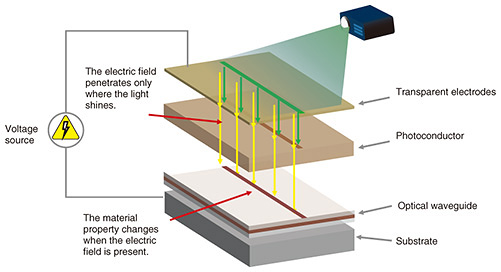
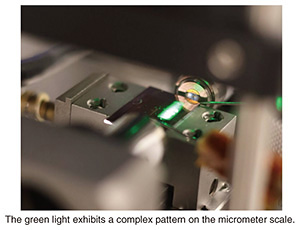
2D-programmable photonics aims to solve problems similar to those addressed with conventional programmable photonics but takes the underlying idea to its extreme. Conventional methods take an approach analogous to a field-programmable gate array: a complex, precisely engineered optical circuit is fabricated and endowed with a few tunable parameters. By contrast, 2D-programmable photonics extends this programmability across the entire device; rather than tuning a few parameters within a fixed circuit, it writes the whole optical circuit into a blank-slate device during operation. The operating principle of 2D-programmable photonics is shown in Fig. 2. The base of this device consists of a slab-like 2D optical waveguide fabricated on a silicon substrate, which at this stage is merely a plate through which light can propagate. The key components are the photoconductive layer and transparent electrode stacked on top of it. When operating the device, a voltage is applied between the transparent electrode and substrate, and a pattern of green light is illuminated from above. The photoconductor absorbs the green light, causing only the illuminated regions to become electrically conductive. This creates an electric-field distribution corresponding to the illuminated light pattern, which is then applied to the 2D optical waveguide. Since the properties of a material generally change when an electric field is applied, the pattern is transferred in the sequence, illumination pattern → electric-field pattern → material-property modulation pattern → optical function, ultimately making it possible to freely rewrite the device function using the illumination pattern. Intuitively, the illumination pattern plays the role of a program that writes a function into the device. The illumination pattern is created using a projector, enabling nearly one million parameters to be updated once per second, with a resolution of several micrometers per pixel (Fig. 3).
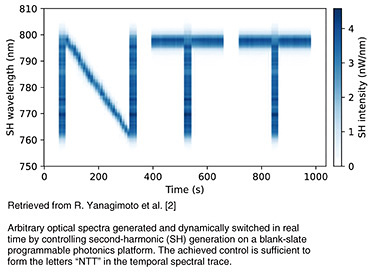
For this study, we fabricated two types of devices using lithium niobate and silicon nitride, respectively, as the core materials of the 2D optical waveguides. In the lithium-niobate device, the electro-optic effect enables us to generate a refractive-index modulation with the same shape as the illumination pattern. In the silicon-nitride device, a second-order nonlinear optical effect is induced in the same shape as the illumination pattern, enabling the color of light to be freely converted. We describe the experimental demonstrations carried out using these two types of devices in the following sections. 3. In lithium niobate: Demonstration of optical computing with light-programmed functionalityOne major societal challenge for which optical technologies are expected to provide a breakthrough is the explosive energy costs in AI datacenters. New forms of computing that use light are the focus of particularly high hopes. To gain intuition for the unique computational capabilities of light, consider eyeglasses. Eyeglasses can be regarded as image-processing computational devices that convert blurry images into sharp ones. What is especially remarkable is that eyeglasses execute this complex task without consuming any energy, continuously processing an enormous stream of data. This example suggests that light can provide extremely efficient computational functionality for certain types of tasks. In our lithium-niobate programmable photonic device, the refractive-index distribution that light exhibits can be freely reshaped. In effect, this corresponds to being able to create “eyeglasses” with extremely complex shapes at will. In the results reported in Nature Physics, we used this capability to demonstrate optical machine learning [1]. As one example, we demonstrated image recognition by encoding images of handwritten digits into the light entering the device. The green-light illumination pattern was optimized so that, after passing through the device, the input light would be focused on a different position depending on the digit. In other words, the green-light illumination pattern effectively writes a program for recognizing handwritten digits into the device. We thus achieved an image-recognition accuracy of 86% on the MNIST (Modified National Institute of Standards and Technology) dataset, with the device effectively executing a 49 × 10 matrix-vector multiplication. As demonstrated in this experiment, programmability is extremely important for applications in optical computing. A computer is, by its very nature, expected to handle multiple tasks; in our device, switching the green-light illumination pattern makes it possible to take on a different task, such as speech recognition. The optical pattern for each task then encodes parameters that must be optimized through learning. With a programmable device, these parameters can be optimized on the spot, without the need to fabricate a new device from scratch each time. Optical computing at practically useful scales demands large, complex devices, and accurately achieving such functionality requires extensive post-fabrication programmability. This work represents an important step toward that goal. A second example in which complexity quickly builds up, making it difficult to accurately “sculpt” devices, is nonlinear optics, which is the subject of our second demonstration, described as follows. 4. In silicon nitride: Demonstration of programmable nonlinear optics for flexible control of light colorThe optics we encounter in everyday life is generally linear optics. This means that beams of light do not collide or interact with one another. Imagine the beams of two flashlights crossing in mid-air: they pass through each other without interacting. In special nonlinear media, however, light can interact strongly, enabling functions that are impossible with ordinary linear optics. For example, nonlinear optics is essential for wavelength conversion that changes the color of light, the generation of entangled light required for quantum computers, and the realization of optical frequency combs. However, the functions of nonlinear optical devices are mainly fixed at the time of fabrication, which limits their range of applications. In our study published in Nature, we demonstrated that nonlinear optical effects can be freely controlled using 2D-programmable photonics with a silicon-nitride core [2, 3]. As shown in Fig. 4, for example, we were able to freely shape the spectrum of light in real time, focus light to different positions depending on its color, and demonstrate functions that keep operating under environmental changes severe enough to render conventional devices inoperable. All these functions were achieved on a single device simply by changing the green-light illumination pattern corresponding to the program. Further improvements in device performance are expected to enable applications such as quantum light generation with freely controllable entanglement, as well as wavelength conversion of quantum optical signals for quantum networks.
5. Toward the future of photonicsWe introduced a novel approach to programmable photonics that enables the real-time writing of optical functions with light on a blank slate. Specifically, we fabricated two types of devices using lithium niobate and silicon nitride as core materials, exhibiting programmable refractive-index modulation and programmable nonlinear optical effects, respectively. The functions we demonstrated include basic optical machine learning, matrix-vector multiplication, and real-time generation of light with broadly tunable spectra. These demonstrations represent only a small fraction of the countless functions that are possible in principle. The ability to reconfigure device functions in real time at the site of use has unprecedented potential for the development and application of optical devices. Conventionally, for instance, the function of a device must be precisely designed and fabricated in advance. With a programmable device, however, it becomes possible to ship a product in a blank-slate form and automatically inverse-design its function in the field on the basis of user feedback. This would enable far more flexible adaptation to environment drifts and changes in target functions, enabling applications that were previously impossible. Several aspects still need improvement before our approach can be widely put into practical use. The current device has a “jack-of-all-trades, master-of-none” character: it can implement any function, but none yet with high performance. In optical computing applications, for example, the scale of computation that can be executed is still small compared with electronic circuits, and in nonlinear optical applications, the wavelength-conversion efficiency remains low. Going forward, further research and development from the perspectives of device designs, material properties, and optical systems will be essential to develop a platform that is not only universal but also high performing. Historically, the form of technology has changed dramatically alongside the evolution of societal challenges. It is entirely possible that optical devices several decades from now will take forms we cannot predict—forms that are not mere extensions of today’s paradigms. Although our research may appear unusual at present, we hope that it can serve as one possible vision of the future of optics. References
|
|||||||