|
|||||||||||||||||||||||
|
|
|||||||||||||||||||||||
|
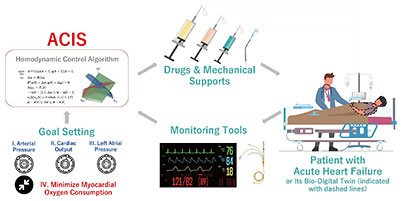
Feature Articles: NTT Research 2.0 ACIS: Hemodynamic Control System for Treating Acute Heart FailureAbstractThe Medical & Health Informatics Laboratories at NTT Research is developing an autonomous therapeutic system for the clinical management of acute heart failure. By integrating treatment algorithms that coordinate pharmacological therapies and medical devices with Bio Digital Twin technology capable of reproducing patient-specific cardiovascular conditions, we aim to establish a novel medical technology that assists clinicians in complex therapeutic decision-making. This article introduces the clinical background, technical overview, and ongoing efforts toward the clinical translation of this system. Keywords: hemodynamic control, Bio Digital Twin, acute heart failure  1. Challenges in acute heart failure treatmentThe number of heart failure patients in Japan continues to increase as the population ages and is projected to reach approximately 1.3 million by 2030. This situation has been referred to as the “heart failure pandemic” [1] and has become a major societal concern. Among various forms of heart failure, acute heart failure is a life-threatening condition characterized by acute deterioration in hemodynamics, requiring rapid and appropriate therapeutic intervention. The treatment of acute heart failure cannot be reduced to simple actions such as raising blood pressure or increasing blood flow. Clinicians must maintain adequate systemic perfusion while simultaneously minimizing cardiac workload. Therefore, complex treatment decisions involving multiple pharmacological therapies and mechanical circulatory support devices are routinely required in clinical practice. Inotropic agents, for example, can improve blood pressure and cardiac output but may also increase myocardial oxygen consumption and place additional stress on the heart. Conversely, therapies intended to reduce cardiac workload may compromise systemic perfusion. Thus, acute heart failure treatment inherently involves trade-offs among multiple therapeutic objectives. The heterogeneity of patient conditions, limitations in physiological measurements available in intensive care units (ICUs) and coronary care units (CCUs), and the complex interactions among drugs and mechanical support devices also make the automation of acute heart failure treatment a significant research challenge. 2. Heart failure treatment as a control problemFrom a control engineering perspective, the treatment of acute heart failure presents three major challenges. The first challenge lies in modeling. Multiple pharmacological therapies and mechanical support devices may act simultaneously, while therapeutic objectives including blood pressure, blood flow, pulmonary congestion, and myocardial oxygen consumption must be considered [2]. Because the cardiovascular system consists of interacting subsystems such as the heart, systemic circulation, pulmonary circulation, and blood volume regulation, the problem is inherently a complex multi-input, multi-output control problem. The second challenge lies in control. In clinical practice, sufficient and accurate physiological measurements are not always available, requiring patient states to be estimated from limited information. Substantial variability exists both among patients and within the same patient over time, making robustness a critical requirement. Optimal treatment decisions must also be determined while accounting for various clinical and physiological constraints, including drug-dosage limits, contraindications, and device limitations. The third challenge lies in validation for clinical translation. Before clinical deployment, autonomous therapeutic systems must undergo multiple stages of evaluation, including simulation studies, animal experiments, retrospective clinical data analyses, and regulatory approval processes. Close collaboration with medical institutions is thus essential for validating the physiological fidelity of simulators, acquiring experimental and clinical data, and understanding regulatory requirements for medical devices [3, 4]. 3. ACIS: An autonomous therapeutic decision-support system for acute heart failureAt the Medical & Health Informatics Laboratories (MEI Lab), we are developing the Autonomous Closed-Loop Intervention System (ACIS), an autonomous therapeutic decision-support system for acute heart failure management* [5]. ACIS is being developed to determine optimal pharmacological and mechanical interventions that maintain key hemodynamic variables, including arterial pressure, cardiac output, left atrial pressure, and right atrial pressure, within their target ranges while minimizing myocardial oxygen consumption (Fig. 1).
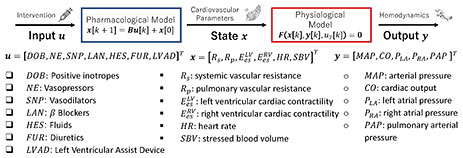
The foundation of ACIS is a cardiovascular mathematical model that integrates pharmacological and physiological representations of the circulatory system (Fig. 2). The pharmacological model predicts the cardiovascular effects of therapeutic agents, whereas the physiological model represents hemodynamics through the interactions among the left heart, systemic circulation, right heart, pulmonary circulation, and blood volume. Mechanical circulatory support devices such as left ventricular assist devices and veno-arterial extracorporeal membrane oxygenation can also be incorporated into the same system, enabling the integrated representation of both pharmacological therapies and medical devices [6]. Because important physiological variables such as cardiac contractility and blood volume cannot be measured directly in clinical settings, ACIS also incorporates state-estimation algorithms that estimate unmeasured physiological states from limited physiological measurements [7, 8].
For treatment planning, ACIS formulates therapeutic intervention as a constrained optimization problem. By maintaining hemodynamic variables within desired ranges while minimizing cardiac workload, the system derives an optimal treatment strategy. Clinical constraints, including drug-dosage limits, contraindications, and device-related restrictions, are explicitly incorporated into the optimization process.
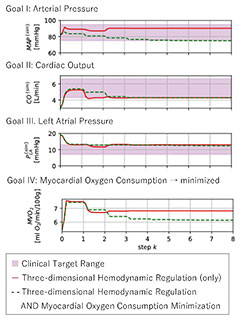
4. Simulation studies using a bio-digital twinWe use a cardiovascular bio-digital twin developed at MEI Lab [9] to evaluate ACIS. In this digital twin, the cardiovascular system is modeled as an equivalent electrical circuit, enabling numerical simulations of a wide range of heart failure conditions. The digital twin also reproduces physiological mechanisms such as the baroreflex, pharmacological interventions, mechanical circulatory support, and renal function. It can thus reproduce complex physiological responses that are difficult to represent using simplified mathematical models alone. We conducted simulation studies involving this bio-digital twin in severe heart-failure scenarios in which ACIS was applied as a therapeutic decision-support system (Fig. 3). The results indicate that ACIS could simultaneously regulate arterial pressure, cardiac output, and left atrial pressure within their target ranges while substantially reducing myocardial oxygen consumption.
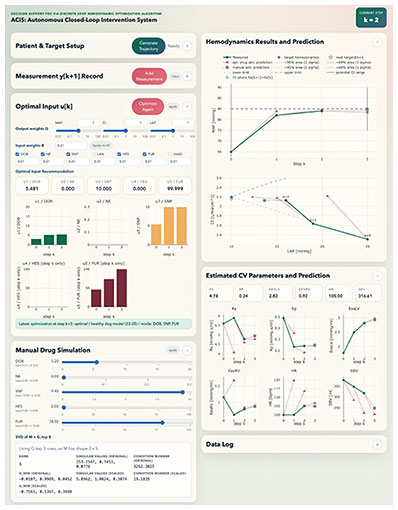
Treatment inputs were updated discretely rather than continuously. This design facilitates clinical translation. Measurements such as cardiac output and left atrial pressure obtained using a pulmonary artery catheter are typically assessed intermittently in ICUs and CCUs. This characteristic has important implications for the clinical translation of ACIS. Specifically, ACIS may function not only as a fully autonomous therapeutic system but also as a clinical decision-support tool that recommends which therapies should be administered and at what dosage. Such staged autonomy is similar to the evolution from driver-assistance systems to fully autonomous vehicles in the automotive industry [10] and is increasingly recognized as an important pathway toward clinical adoption. With this system, physicians retain ultimate responsibility for treatment decisions, while it analyzes complex hemodynamic conditions and supports therapeutic decision-making. 5. Toward clinical translationAt MEI Lab, we are also developing a clinical decision-support application designed for the practical use of ACIS in real-world healthcare settings (Fig. 4). The application displays the drug combinations and dosage recommendations generated by ACIS, together with the predicted hemodynamic responses associated with those interventions. To enhance interpretability, the system also presents the expected changes in key cardiovascular parameters, enabling clinicians to understand the causal relationship between therapeutic interventions and their predicted physiological effects. Visualization features are also being refined to enable comparisons between ACIS recommendations and the treatment strategies selected by physicians, thus facilitating its use as a clinical decision-support tool.
To advance the clinical translation of ACIS, we are conducting pre-clinical studies, clinical tuning, and continuous enhancement of the application in collaboration with the National Cerebral and Cardiovascular Center, Japan. Through these efforts, we aim for this system to be effectively deployed in real-world clinical practice. 6. Conclusion and future perspectivesThis article introduced ACIS for acute heart failure being developed at MEI Lab. A key feature of ACIS is its ability to simultaneously optimize multiple hemodynamic variables while integrating both pharmacological therapies and mechanical circulatory support. Although acute heart failure management requires extensive clinical expertise and experience, ACIS is being developed to support clinicians in making complex treatment decisions. MEI Lab is also developing technologies to estimate patient-specific physiological parameters and construct digital replicas of individual patients. Such bio-digital twins may enable clinicians to evaluate and compare multiple treatment strategies in a virtual environment. For example, they may help determine whether pharmacological therapy alone is sufficient or whether mechanical circulatory support should be considered, thus supporting clinical decision-making. We envision medical autonomy as a technology that assists rather than replaces physicians in delivering safer and higher-quality care. We envision integrating patient-specific bio-digital twins with autonomous control technologies to create healthcare systems capable of providing personalized and real-time therapeutic support. Achieving this vision will require broad collaboration among healthcare professionals, researchers, medical device manufacturers, and regulatory agencies. This challenge can only be achieved through the integration of multiple disciplines, including control engineering, cardiovascular medicine, medical device engineering, and, ultimately, artificial intelligence technologies. Through academic activities, collaborative research, and participation in international communities, MEI Lab will continue to promote a global and open ecosystem for advancing this field. 7. Message to readersThe automation of heart failure treatment represents an important research frontier for next generation healthcare. MEI Lab is engaged in pioneering research and development in this area. If you are interested in autonomous therapeutics or Bio Digital Twin technologies, we encourage you to follow our future activities and developments. References
|
|||||||||||||||||||||||