|
|||||||||||||||||
|
|
|||||||||||||||||
|
Feature Articles: Keynote Speeches and R&D on Access Networks Presented at Tsukuba Forum 2026 Research and Development Initiatives to Construct Future Access NetworksAbstractNTT Access Network Service Systems Laboratories (AS Labs) conducts research and development (R&D) to support access networks across the fields of optical and wireless communications, infrastructure facilities, and operations. In response to the changing environment surrounding access networks, this article presents AS Labs’ vision for future access networks and describes the key technical challenges and major R&D initiatives in each technology domain for achieving that vision. Keywords: optical and wireless communications, infrastructure facilities, operations  1. Future access networks and challenges to their constructionNTT Access Network Service Systems Laboratories (AS Labs) conducts research and development (R&D) to support access networks (NWs) across a wide range of technological domains, including optical communications, wireless communications, infrastructure facilities, and NW operations, with the aim of contributing to new value creation and a sustainable society. When considering the future of access NWs, the following changes in the environment surrounding access NWs are regarded as particularly significant. (1) Population and urban dynamics: As Japan’s population decline accelerates [1], the workforce is expected to shrink not only across various industries but also among the personnel who construct and operate access NWs. Continuing depopulation is expected to lead to more compact residential areas. Therefore, differentiated approaches to designing and operating access NWs will be required, reflecting the distinct characteristics of densely populated, high-traffic urban areas and sparsely populated, low-traffic rural areas. (2) Aging infrastructure: As the proportion of roads, tunnels, water-supply systems, and other social infrastructure in service for over 50 years continues to increase [2], the telecommunications sector is expected to play an increasingly important role in addressing the associated challenges. (3) Migration from copper-line services: As copper-line services migrate to optical and mobile NWs [3, 4], key challenges include removing a vast amount of copper-line infrastructure and constructing access NWs in the post-copper era. (4) Changing patterns of NW use: According to traffic forecasts, NW traffic volume around 2040 is expected to be approximately 90 to 300 times higher than that in 2020 [5]. NW traffic is expected to shift from being dominated by human-centric applications (such as video streaming, social networking services, and web browsing) to artificial intelligence (AI), mobility, robotics, and the Internet of Things (IoT). In response to these changes, NTT has presented its vision of an AI-native infrastructure that supports not only human-to-human communications but also machine-to-machine and AI/robot-to-AI/robot communications, as well as edge data processing, including real-time AI inference [6]. In response to these changes, we at AS Labs envision the future of access NWs as described below to support a society that will continue to evolve with AI.
To construct such future access NWs, we are advancing R&D to address the following key challenges in each technology domain:
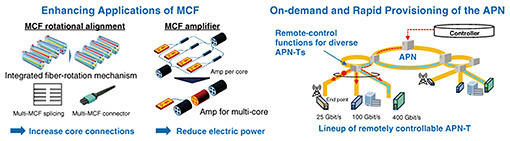
2. Activities in optical communicationsTo increase the capacity of optical infrastructure, we are expanding the use of multi-core optical fiber (MCF). As AI and cloud services continue to develop, MCF is expected to be used increasingly to expand capacity, particularly in datacenters (DCs). Two challenges must be addressed: increasing the number of cores that can be connected per single operation and reducing power consumption of optical amplifiers. For the former, we are studying a high-count integrated fiber-rotation mechanism that rotates each fiber in a densely packed array to align the positions of its cores. For the latter, we are studying energy-efficient four-core amplification using a single pump light. To create APN services, we are developing remote-control technologies and expanding the lineup of APN transceivers (APN-Ts) to enable services to be provided rapidly and on-demand. One example is a plug-and-play function that automatically activates a service when the transceiver is connected. By eliminating the need to dispatch field engineers, this function can reduce activation time. We are also developing APN-Ts with different transmission rates to support a wide range of use cases, including mobile fronthaul, interconnections between enterprise DCs, and inter-DC links and transport NWs within cloud-service providers. The goal is for all these transceivers to support remote control (Fig. 1).
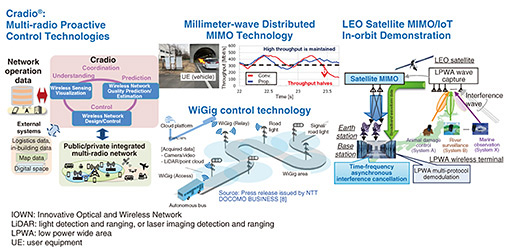
3. Activities in wireless communicationsReal-time applications that cannot tolerate communication interruptions are expanding, increasing the need for higher-quality wireless access. To improve wireless-access quality, we are developing Cradio®, a suite of technologies that achieves seamless wireless connectivity by integrating wireless NW design, real-time sensing, and wide-area quality prediction. By integrating Cradio with NW operation data and external data (such as logistics data, in-building data, and map data), we are developing a framework that enables wireless environments to be monitored in real time, wireless quality to be predicted over wide areas, and control of multiple wireless systems to be coordinated. This framework will enable multi-radio services that can adapt to high-speed mobility and dynamically changing wireless environments, enabling use cases such as remote driving in smart cities, digital transformation (DX) at factories and construction sites, and drone-based monitoring. To promote the use of millimeter-wave bands, we are pursuing stable, high-capacity communications in obstructed environments through distributed multiple-input multiple-output (MIMO) and Wireless Gigabit (WiGig) control technologies. We are conducting field demonstrations of distributed MIMO in tunnels [7] and WiGig control as part of autonomous-bus field trials [8]. Through these trials, we aim to expand millimeter-wave use across a wider range of scenarios. To promote the use of NTNs, we are conducting an in-orbit demonstration of MIMO and IoT using a low-Earth-orbit (LEO) satellite in collaboration with the Japan Aerospace Exploration Agency. Our key technical contribution is increasing satellite communication capacity by applying MIMO transmission. This is the world’s first demonstration of MIMO transmission using a LEO satellite. Through this technology, we aim to improve the accuracy of various types of satellite observation and enable large-scale satellite-sensing services (Fig. 2).
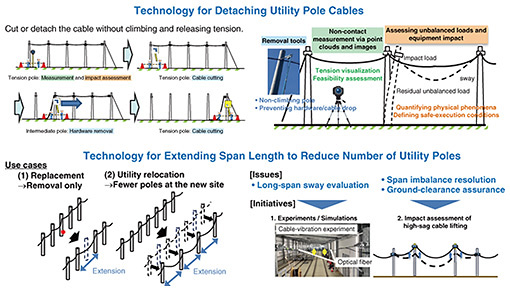
4. Activities in infrastructure facilitiesWe are conducting two research initiatives aimed at preparing for the post-copper era in communications infrastructure. The first is copper-cable removal technology. We are studying technologies for safely cutting and removing aerial copper cables without releasing their tension or requiring workers to climb utility poles. These include removal tools that balance operation efficiency and safety, methods that use point-cloud data and images to visualize on-site cable tension and assess the feasibility of the proposed removal technology, and techniques for evaluating the effects of unbalanced and impact loads on cables and utility poles to identify conditions for safe removal. Through these technologies, we aim to reduce the costs of maintaining and removing aerial copper cables while ensuring the safety of workers and infrastructure. The second is span-extension technology for reducing the number of utility poles. After copper cables are removed, we aim to extend the spans between poles, thereby reducing the number of poles, to fundamentally lower infrastructure-maintenance costs. Specifically, we are assessing the effects of long-span vibration through experiments and simulations and evaluating the impact on infrastructure of a method for raising heavily sagging cables that both eliminates load imbalance and maintains the required ground clearance (Fig. 3).
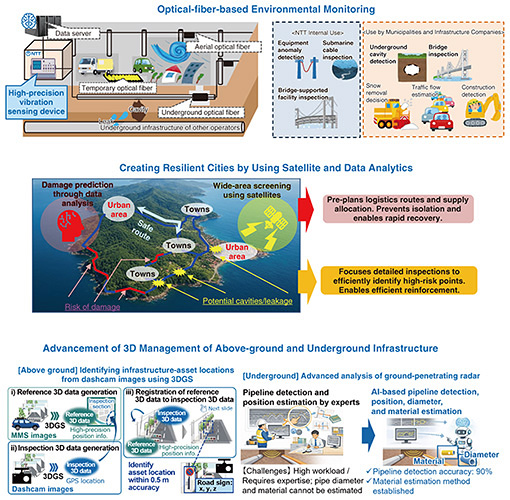
Next, we introduce our efforts to extend these technologies to social infrastructure. The first effort is optical-fiber-based environmental monitoring, which uses existing optical fibers to construct a sensor NW. We have been developing high-precision vibration-sensing technology and are now advancing techniques for analyzing vibration data for specific use cases. Through these efforts, we aim not only to apply the technology to NTT facilities but also establish technologies for addressing a range of social-infrastructure challenges, including detecting underground voids and inspecting bridges. Our work on satellite sensing and data analytics aims to strengthen regional disaster resilience by visualizing risks associated with major disasters such as earthquakes and torrential rainfall. One key technology is a model for predicting utility-pole damage originally developed for telecommunications infrastructure. By applying this technology to estimate road conditions in advance, we can support evacuation planning and emergency logistics, helping prevent communities from becoming isolated during disasters. Another technology uses satellite radio-wave analysis to screen for anomalies, including those below the ground surface. By monitoring subsurface anomalies beneath critical roads using satellite imagery, we aim to help prevent road collapses. We are also advancing three-dimensional (3D) technologies for managing aboveground and underground infrastructure. For aboveground infrastructure, we are developing a technology that uses 3D Gaussian splatting (3DGS) to identify the locations of infrastructure assets from dashcam images. Through highly accurate localization, we aim to reduce maintenance workloads and costs, predict future infrastructure deterioration, and enable urban-planning and disaster-prevention simulations. For underground infrastructure, we are enhancing ground-penetrating radar waveform analysis using AI. By establishing methods for estimating the location, diameters, and materials of buried pipes, we aim to contribute to the DX of social-infrastructure maintenance (Fig. 4).
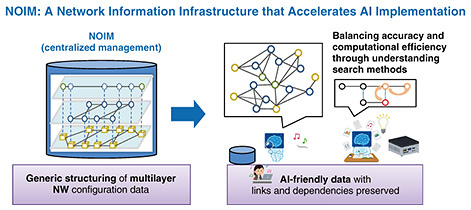
5. Activities in operationsAI is a key enabler for achieving autonomous NW operations. Current challenges include the lack of centralized management of NW configuration information, which remains fragmented across disparate repositories, and the substantial effort required for use-case-specific tuning to enable AI to understand NW connectivity and dependency relationships. To address these challenges, we are developing the Network Operation Injected Model (NOIM), a NW-information platform designed to accelerate AI adoption. NOIM represents multilayer NW configuration information, from the physical layer to the service layer, in a general-purpose data format. It also provides this information to AI while preserving connectivity and dependency relationships, enabling AI to efficiently traverse the NW information while maintaining both accuracy and computational efficiency. Through these technologies, we aim to accelerate the adoption of AI for complex NW operations and achieve autonomous and automated NW operations (Fig. 5).
6. ConclusionThis article presented AS Labs’ vision for future access NWs and the key initiatives supporting its actualization. We will continue to advance this vision by increasing the capacity of optical infrastructure and creating APN services in optical communications; improving wireless access quality and promoting the use of millimeter-wave technologies and NTNs in wireless communications; preparing for the post-copper era and extending infrastructure technologies to social infrastructure; and achieving autonomous NW operations. References
|
|||||||||||||||||