|
|||||||||||||
|
|
|||||||||||||
|
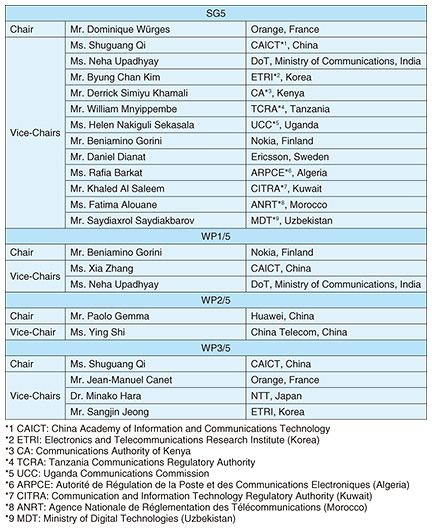
Global Standardization Activities Report of the Third Meeting of ITU-T Study Group 5—Spotlighting Standardization Activities on Watt-bit Collaboration and Product Category Rules for Carbon Footprint of SoftwareAbstractThe International Telecommunication Union - Telecommunication Standardization Sector (ITU-T) Study Group 5 (SG5): “Environment, climate action, circular economy and electromagnetic fields” aims to develop international standards to promote an environmentally sustainable, resilient, and inclusive telecommunications/information and communication technology (ICT) sector. It focuses on enabling safe, resilient, efficient, and responsible ICT development through global standardization. This article reports on the deliberations at the third meeting of ITU-T SG5 for the 2025–2028 study period, held in Sophia Antipolis, France, 9–18 June 2026, spotlighting the approval of two new work items: the watt-bit collaboration framework and product category rules for carbon footprint of software. Keywords: ITU-T SG5, watt-bit collaboration, carbon footprint of software  1. Summary of the third meeting of ITU-T SG5The third meeting of the International Telecommunication Union - Telecommunication Standardization Sector (ITU-T) Study Group 5 (SG5) for the 2025–2028 study period was held in Sophia Antipolis, France, from 9 to 18 June 2026. A total of 216 participants from 43 countries attended the meeting, with 20 participants from Japan (6 on-site and 14 attending remotely). The meeting was chaired by Mr. Dominique Würges (Orange, France). Vice-chairs who attended on-site were Ms. Shuguang Qi (CAICT, China), Mr. Derrick Simiyu Khamali (CA, Kenya), Mr. William Mnyippembe (TCRA, Tanzania), Ms. Helen Nakiguli Sekasala (UCC, Uganda), Mr. Beniamino Gorini (Nokia, Finland), and Mr. Daniel Dianat (Ericsson, Sweden). Vice-chairs who attended remotely were Mr. Khaled Al Saleem (CITRA, Kuwait), Ms. Rafia Barkat (ARPCE, Algeria), and Ms. Fatima Alouane (ANRT, Morocco) (Table 1).
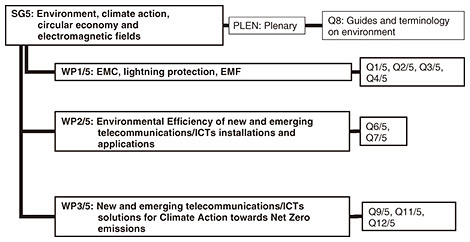
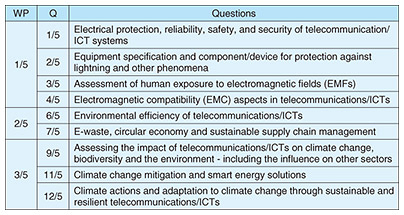
A total of 154 contributions were considered, including 2 from Japan. Twenty-four draft recommendations were consented, 9 of which were revised recommendations. Other texts were agreed, 4 of which were supplements and 1 was a technical report (Fig. 1, Table 2).
2. Discussions and results by Working Parties (WPs)2.1 WP1/5 – Electromagnetic compatibility (EMC), lightning protection, electromagnetic field (EMF)WP1/5 was chaired by Mr. Beniamino Gorini (Nokia, Finland), with Vice-Chair Ms. Xia Zhang (CAICT, China) participating remotely. Under Questions 1 to 4, three revised draft recommendations were submitted for consent, and one draft supplement was submitted for agreement. 2.1.1 Question 1/5: Electrical protection, reliability, safety, and security of telecommunication/information and communication technology (ICT) systemsQuestion 1/5 considers protection requirements for telecommunication systems against lightning strikes, earthing, and disturbances from power systems. It also studies electromagnetic security issues for telecommunication facilities, such as protection methods against high-altitude electromagnetic pulses and high-power electromagnetic attacks, as well as risk evaluation and mitigation methods for information leakage via electromagnetic waves. Associate Rapporteur Mr. Huagang Wang (China Telecommunications, China) led the session. Following the retirement of former Rapporteur Mr. Chuanyou Dai (Huawei, China), Mr. Chen Qiang (China Unicom, China) was newly appointed as rapporteur. Two contributions were considered. NTT submitted a draft first revision of existing Recommendation K.87 “Guide for the application of electromagnetic security requirements – Overview,” proposing modifications to terms/definitions and a review of referenced standards. It was decided to open a new work item about the revision of existing Recommendation K.105 “Lightning protection of photovoltaic power supply and energy storage systems feeding radio base stations.” 2.1.2 Question 2/5: Equipment specification and component/device for protection against lightning and other phenomenaQuestion 2/5 considers protection requirements, protection components, and devices for telecommunication equipment against overvoltage and overcurrent. Rapporteur Mr. Eiichi Kobayashi (NTT, Japan) led the session, and six contributions were discussed. NTT submitted a draft revision of existing Recommendation K.21 “Resistibility of telecommunication equipment installed in customer premises to overvoltages and overcurrents,” compiling revision details discussed up to the previous meeting regarding internal Ethernet port resistibility and insulation performance requirements, which was submitted for consent. NTT and India proposed to reflect updated relevant standards on overvoltage protection and initiate consideration for revising existing Recommendation K.11 “Principles of protection against overvoltages and overcurrents.” It was decided to open it as a new work item. The publication of Supplement K.Sup_tov “Supplement to Recommendation ITU-T K.11 – Protection of ICT equipment with direct current (DC) power supply against temporary overvoltage (TOV) in telecommunication centre” was also submitted for agreement. 2.1.3 Question 3/5: Assessment of human exposure to EMFsQuestion 3/5 considers estimation procedures, calculation methods, and measurement methods for EMF strength in the vicinity of mobile phones and wireless system antennas in terms of human exposure. Co-Rapporteur Ms. Helen Nakiguli Sekasala (UCC, Uganda) led the session, and 14 contributions were discussed. It was decided to open three work items on: the revision of existing Recommendation K.70 “Mitigation techniques to limit human exposure to EMFs in the vicinity of radiocommunication stations,” new Technical Report KSTR-AI.EMF “EMF evaluation method using artificial intelligence in the vicinity of 5th-generation mobile communication systems (5G) New Radio (NR) base station,” and the revision of existing Supplement K.Sup.14 “The impact of RF-EMF exposure limits stricter than ICNIRP or IEEE guidelines on 4G and 5G mobile network deployment.” The establishment of an international portal to aggregate and provide national EMF exposure limits from each country was also proposed. This was discussed during the WP1/5 closing plenary, and SG5 secretariat will provide an assessment of the feasibility of this global portal to the next SG5 meeting. 2.1.4 Question 4/5: EMC aspects in telecommunications/ICTsQuestion 4/5 considers EMC standards corresponding to new telecommunication equipment, services, and wireless systems, as well as the maintenance of existing recommendations. Co-Rapporteurs Mr. Beniamino Gorini (Nokia, Finland) and Mr. Xing Hai Zhang (Huawei, China) led the session, and four contributions were discussed. The draft revisions of existing Recommendations K.74 “Electromagnetic compatibility, resistibility and safety requirements for home network devices” and K.92 “Conducted and radiated electromagnetic environment in home networking” were submitted for consent. It was decided to open two new work items on revising these two recommendations. 2.2 WP2/5 – Environmental efficiency of new and emerging telecommunications/ICTs installations and applicationsWP2/5 was chaired by Mr. Paolo Gemma (Huawei, China), with Vice-Chair Ms. Ying Shi (China Telecommunications, China). Under Questions 6 and 7, three new draft recommendations and six revised draft recommendations were submitted for consent, and two draft supplements were submitted for agreement. 2.2.1 Question 6/5: Environmental efficiency of telecommunications/ICTsQuestion 6/5 considers eco-efficiency for new advanced technologies such as telecommunications/ICTs and metaverse. Co-Rapporteurs Mr. Magnus Olsson (Huawei, China) and Ms. Ying Shi (China Telecommunications, China) led the session, and 40 contributions were discussed. The draft revisions of existing Recommendations L.1203 “Colour and marking identification of up to 400 VDC power distribution for information and communication technology systems” and L.1331 “Assessment of mobile network energy efficiency,” as well as draft new Recommendations L.FR-ESC “Framework and requirements of environmentally sustainable computing,” L.IEDL “Energy saving strategy for deep learning computing,” and L.Energy_sav_Cloud & Edge “Energy saving design for data centre considering harmonizing of cloud and edge” were submitted for consent. It was decided to open 11 new work items: revisions of existing Recommendations L.1220 “Innovative energy storage technology for stationary use - Part 1: Overview of energy storage” and L.1300 “Requirements and best practices for green data centres,” new Recommendations L.AIA_RS “Framework of AI agents in resource scheduling for environmentally efficient data center infrastructure,” L.EE_Token “Token-based evaluation framework for energy and carbon efficiency of AI inference,” L.CTS_CP “Computing Task Scheduling Framework considering Computing power and Electric Power Coordination,” L.WBC-FR “Framework for Industrial Advancement through Distributed Data Centre Workload Shifting for Watt-Bit Collaboration,” L.NEE_DCI “Energy efficiency assessment of dedicated network that interconnects data centres,” L.HESS-AIDC “General requirements for hybrid energy storage for AI data centres,” and L.GLOC_DC “Guidelines for green and low-carbon operation control of water cooling system in data centres,” new Supplement L.Sup.Ex_RAN_emis “Practical examples on the determination of CO2e emission of mobile networks,” and new Technical Report LSTR-DC-WaterEnv “Water environment sustainability evaluation framework for data centers utilizing natural surface water cooling.” One new draft Supplement L.Sup.MDEE “Study of multi-dimensional network energy efficiency metrics” was also submitted for agreement. It was also decided to close L.fra_cooling “Functional requirements and adoption of cooling technologies for ICT implementations.” 2.2.2 Question 7/5: E-waste, circular economy and sustainable supply chain managementQuestion 7/5 considers environmental requirements for telecommunications/ICT based on circular economy concepts and improved supply chain management, as well as programs such as eco-rating and a digital product passport (DPP) for the environmental performance of products, networks, and services. Co-Rapporteurs Ms. Susanna Kallio (Nokia, Finland) and Ms. Hoda Shakra (MICT, Egypt) led the session, and 25 contributions were discussed. The draft revision of existing Recommendation L.1022 “Circular economy: Definitions and concepts for circular economy for information and communication technology” and three draft corrigenda to existing Recommendations L.1004 “Universal fast-charging solution for mobile terminals,” L.1037 “Requirements for the collection, transportation, storage, dismantling, valorization and final disposal of waste electrical and electronic equipment (WEEE),” and L.1041 “Resource saving, e-waste reduction, energy saving system methodology using twisted single-pair cable” were submitted for consent. It was decided to open three new work items: new draft Recommendations L.Digital_EPR “Framework for digital and interoperable implementation of extended producer responsibility (EPR) systems” and L.QA_AI “Quality assessment and verification of AI computing power resources for reuse,” and new Supplement L.Sup.9RC “Guidance for incorporating circularity actions and strategies for ICT manufacturers.” One draft Supplement L.Sup.GSP “Specific principles for the green supply chain management of information and communication technology manufacturing industry” was also submitted for agreement. 2.3 WP3/5 – New and emerging telecommunications/ICTs solutions for Climate Action towards Net Zero emissionsWP3/5 was chaired by Ms. Shuguang Qi (CAICT, China), with Vice-Chairs Mr. Jean-Manuel Canet (Orange, France), Dr. Minako Hara (NTT, Japan), and Mr. Sangjin Jeong (ETRI, Korea). Under Questions 9, 11, and 12, seven new draft recommendations were submitted for consent, and one supplement and one technical report were submitted for agreement. 2.3.1 Question 9/5: Assessing the impact of telecommunications/ICTs on climate change, biodiversity and the environment - including the influence on other sectorsQuestion 9/5 develops sustainability impact assessment methodologies and guidance for telecommunications/ICTs, artificial intelligence (AI), IMT (International Mobile Telecommunications)-2020 (5G), etc., aligning development trajectories with the Paris Agreement and United Nations Sustainable Development Goals. It focuses on climate change and biodiversity challenges and examines how environmental assessment methodologies are used within broader sustainable development assessments, including economic, environmental, and social perspectives. Rapporteur Mr. Jean-Manuel Canet (Orange, France) led the session, and 41 contributions were discussed. Five draft Recommendations L.Env_DC “Guidelines on Multi-Dimensional Environmental Metrics and Management for Data Centres,” L.Carbon_DA “Guideline for Data Annotation for GHG emissions verification Knowledge Graph,” L.PCF_Server “Guidelines for the assessment of the carbon footprint of a server,” L.PCF_Smartphone “Guidelines for the assessment of the carbon footprint of a smartphone,” and L.BatteriesLCA “Guidelines for the assessment of the carbon footprint of Lithium-ion Battery Products for ICT application” were submitted for consent. It was decided to open four items: revision of existing Recommendation L.1400 “Overview and general principles of methodologies for assessing the environmental impact of information and communication technologies,” new Recommendations L.CCEP_CRA “Methodology for assessing carbon reduction benefits of coordinated computing and electrical power operation,” L.PCF Management “Guidelines for managing the carbon footprint of critical equipment in the supply chain of telecommunication operators,” and L.PCRSoftware “Carbon Footprint of Products- Product Category Rule (CFP-PCR) for Software.” One draft Supplement L.Sup.CE_Shared_BS to ITU-T L.1420 “Carbon Emission Accounting and Allocation Methods for infrastructure Shared Base Station Sites” was also submitted for agreement. 2.3.2 Question 11/5: Climate change mitigation and smart energy solutionsQuestion 11/5 formulates recommendations on requirements for smart energy solutions to promote climate change mitigation for other sectors, such as transportation, building, and manufacturing, as well as power supply system interfaces and protocol specifications considering interconnection with smart grid/smart energy solutions. Rapporteur Mr. Sangjin Jeong (ETRI, Korea) led the session, and 12 contributions were discussed. One draft Recommendation L.GEMS_VPP “Framework of Greenhouse Gas Emission Management System for Virtual Power Plant Application” was submitted for consent. It was decided to open four items: new Recommendations L.FADR “Framework and functional requirements for edge-driven automated demand response,” L.SESS “Framework of management platform for shared battery-based energy storage system supporting renewable energy generation to climate change mitigation,” L.FR_CEC “Framework and requirements for computing power and electric power coordination in support of climate change mitigation,” and L.Platform_CEC “Requirements for computing power and electric power coordination platform for climate change mitigation.” One draft Technical Report LSTR.GHG-DR “Mechanism and framework of power grid demand response based on greenhouse gas emission factor” was also submitted for agreement. 2.3.3 Question 12/5: Climate actions and adaptation to climate change through sustainable and resilient telecommunications/ICTsQuestion 12/5 formulates recommendations on climate change mitigation and adaptation for enhancing climate resilience in rural and urban areas, technical specifications for low-cost and portable ICT solutions, and energy efficiency requirements, indicators, key performance indicators, and measurement methods. Co-Rapporteurs Mr. Derrick Simiyu Khamali (CA, Kenya) and Mr. Rumeng Tan (China Telecommunications, China) led the session, and 11 contributions were discussed. One draft Recommendation L.ICT_VPP “Framework and methodology for assessing ICT-based virtual power plants to climate change mitigation” was submitted for consent. It was decided to open one new work item on Technical Report LSTP-ICT4DR “A Strategic Technical Guide on Harnessing Emerging ICTs for Climate Adaptation and Disaster Resilience.” For L.PT_Sharing “Best practices on pole and tower sharing for mitigation of climate change,” which was also proposed as a new work item, it was agreed during the WP3/5 Plenary to transfer it to Question 6/5. It was also agreed to convert draft Recommendation L.LCArural “Low-cost and sustainable ICT solutions for climate change adaptation in rural areas and communities” into a technical report. During the opening plenary, Mr. Rumeng Tan (China Telecommunications, China) was newly appointed as a co-rapporteur. 3. Approval of new work item for “watt-bit collaboration” frameworkThis section reports on the deliberation results and international negotiation background leading to the approval of a new work item on “watt-bit collaboration,” led by Japan, at this meeting. 3.1 Summary and background of the Japanese proposalWith the widespread adoption of generative AI, the explosive increase in power consumption by datacenters has become a global challenge. In response, Japan has been advocating the concept of watt-bit collaboration, which dynamically and organically optimizes and synchronizes the processing of computing resources (bit) with energy supply (watt) to achieve power savings across the entire infrastructure. At this meeting, Japan proposed draft new Recommendation L.WBC-FR “Framework for Industrial Advancement through Distributed Data Centre Workload Shifting for Watt-Bit Collaboration.” This proposal is deeply rooted in discussions and policy directions from the Public-Private Council for Watt-Bit Collaboration in Japan. Its objective is to specify a cross-domain collaboration framework and interface requirements between power and ICT systems to achieve advanced workload shifting while ensuring quality of service across small- to large-scale distributed datacenter environments. For the standardization of this proposal, numerous major entities spanning industry, academia, and government in Japan—including NTT, domestic carriers, vendors, and academic institutions—participated as supporting members and submitted a joint proposal. 3.2 Overlap issues with other proposals and consensus building led by NTTDuring deliberations at this meeting, multiple new work item proposals regarding coordination between computing power and electric power were presented by overseas companies and organizations, specifically three proposals from China Telecom, CAICT, State Grid Corporation of China, China Unicom, and others. Because both these proposals and the Japanese proposal addressed the common theme of “coordination between computing power and electric power,” the meeting chair and other member states pointed out operational overlaps and duplications, leading to discussions that included potential merger of proposals. To resolve this issue, intensive on-site offline discussions were conducted during the meeting period. NTT played a leading role in these coordination efforts, clearly demarcating differences in use cases and technical scope targeted by each proposal. By logically explaining the unique technical domain and features of the Japanese proposal, the distinct positioning of each proposal was established. As a result of negotiations, unanimous consensus was reached to launch all “four independent new work items” in full parallel. The four agreed work items are as follows:
Through this agreement, the Japanese proposal (L.WBC-FR) secured approval as an independent new work item and was decided to be studied under Question 6/5, which specializes in smart-energy-related technologies. The approval of this Japanese proposal represents the concrete realization in international recommendation drafting of high-level agreements reached at the “ITU-T CxO Roundtable” hosted by Director Seizo Onoe of the ITU Telecommunication Standardization Bureau (TSB). This marks a meaningful milestone validating the director’s commitment to “industry engagement.” 3.3 OutlookWith the consensus achieved at this meeting, Japan’s watt-bit collaboration has established a framework to initiate international standardization work as a key pillar in ITU-T SG5. Moving forward, while aligning progress with use cases and key components to be agreed upon in common reference standards (such as L.FR_CEC), efforts will proceed in close cooperation with domestic committees, global stakeholders, and industry-academia-government partners to refine technical requirements toward the initial goal of achieving recommendation consent in 2028. 4. Approval of new work item for product category rules for carbon footprint of softwareThis section reports on the deliberation results and discussions leading to the approval of a new work item regarding “product category rules for carbon footprint of software” at this meeting. 4.1 BackgroundSince COP26 (26th UN Climate Change Conference of the Parties) held in 2021, over 120 countries worldwide including Japan (as of November 2021) have set targets to achieve carbon neutrality by 2050 toward decarbonization. In industry, movements demanding corporate sustainability disclosures aimed at reducing greenhouse gases (GHG) including CO2 have also been accelerating. Against this backdrop, an unprecedented surge in electricity demand is expected in the ICT sector due to AI utilization and data growth, making power efficiency and GHG mitigation in software domains crucial alongside conventional hardware-centric measures. While various challenges in the software domain regarding GHG emissions have been cited—such as lack of legal enforceability, absence of evaluation systems for reduction value, and operational effort and cost [1]—a key underlying factor is that software does not directly consume electricity or emit CO2, making it difficult to perceive environmental impact and preventing environmental awareness from embedding in software development projects. Although monetary-based emission calculation methods exist, calculation rules reflecting reduction efforts during development and operation independent of monetary value were lacking, making precise visualization of software-related CO2 emissions difficult. To resolve these challenges, NTT and software-related companies in Japan collaborated to advance discussions on “Product Category Rules (PCR) for Carbon Footprint of Products (CFP) for Software.” The first edition of these calculation rules was completed and published in March 2024 [2] with support from the Ministry of Economy, Trade and Industry (METI)’s “FY2023 Support Project for Formulating Product Category Rules for Carbon Footprint to Promote GX” [3]. Subsequently, continuous refinement was conducted through the Japan Environment Club Study Group on Decarbonization in the Software Sector [4], leading to the publication of the third edition of the calculation rules in March 2026 covering the entire software lifecycle. In addition to reviewing calculation rules, the study group conducts collaborative promotion activities for industry deployment. 4.2 Summary of contributionTo achieve international standardization of the above-mentioned software carbon footprint product category rules, NTT and partner companies jointly proposed a new work item for draft Recommendation L.PCRSoftware “Carbon Footprint of Products - Product Category Rule (CFP-PCR) for Software.” ITU-T SG5 has long conducted various discussions on ICT and the environment, formulating guidelines to visualize CO2 emissions across ICT services and products. Recently, new initiatives, such as the Green Software Foundation [5], have also become active, drawing increasing attention to this field. However, to further accelerate GHG emission reductions in the software industry, it is essential to promote business-based emission calculation and disclosure, enabling the selection of lower-carbon software. To this end, contributions and discussions were conducted emphasizing the need for global, concrete CFP calculation rules tailored specifically to software. 4.3 Discussions and resultsDiscussions focused on clarifying the differences from the following relevant existing standards.
After highlighting differences from existing standards across three perspectives—granularity of calculation methodology, target scope in the software lifecycle process, and target audience of the standard—the importance of the proposed item was demonstrated, leading to approval for establishing this new work item. With the consensus reached at this meeting, “L.PCRSoftware” proposed by Japanese companies is ready to begin discussion, independently from existing related work items. This work item will be proceeded in close collaboration with stakeholders toward the initial target of achieving recommendation consent in 2027.
References
|
|||||||||||||