|
|||||||||||||||||
|
|
|||||||||||||||||
|
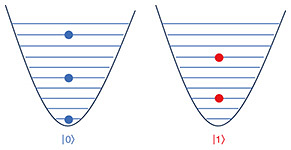
Feature Articles: Pioneering Optical Quantum Computers through Optical Communication Technologies Research toward Quantum Error Correction in Optical Quantum ComputersAbstractQuantum error correction is essential for putting large-scale quantum computers into practical use because quantum information is extremely fragile. This article outlines the concept of bosonic codes, which encode quantum information in the energy levels of harmonic oscillators such as optical modes. We then introduce NTT’s theoretical work on squeezed cat codes. By exploiting their translational symmetry, we construct a unified framework for autonomous quantum error correction without measurement and feedback, as well as for logical operations and readout. This symmetry-based approach may reduce hardware overhead and provide a route toward practical bosonic quantum computing. Keywords: quantum error correction, bosonic codes, squeezed cat codes  1. Continuous-variable quantum error correctionQuantum computers are next-generation computers expected to find applications in a wide range of fields, including chemistry, materials development, and machine learning. As their name suggests, quantum computers execute calculations by exploiting properties unique to quantum mechanics, such as superposition and quantum entanglement. This may enable certain problems that require an extremely long time on conventional computers to be solved dramatically faster. However, these quantum properties are also extremely fragile. Delicate quantum states such as the superpositions and entangled states needed for quantum computation can be disturbed by even slight influences from the external environment, resulting in computational errors. Suppressing such errors is therefore one of the greatest challenges in developing practical quantum computers. Quantum error correction (QEC) is essential for overcoming this challenge. In conventional QEC, one logical qubit is encoded using multiple physical qubits. The resulting redundancy is used to determine what kind of error has occurred and apply an appropriate correction. Consider encoding logical 0 as 000 and logical 1 as 111 using three physical qubits. If an error changes the logical-0 state from 000 to 001, we can identify the rightmost qubit as the one affected by the error and restore the state to 000. Actual QEC requires more sophisticated procedures so that measurements do not destroy the superposition states used as computational resources, but the basic idea is the same: errors are detected and corrected by introducing redundancy. QEC, however, comes with substantial overhead because many physical qubits are needed to protect a single logical qubit. Although quantum hardware has advanced rapidly, the number and quality of currently available physical qubits are still insufficient for large-scale fault-tolerant computation. Applying QEC therefore greatly reduces the number of logical qubits that can be used for computation. For the surface code, one of the best-known QEC codes, at least several tens of physical qubits are thought to be required for a single logical qubit, depending on the target error rate, and practical calculations may require several hundred or more. Controlling so many physical qubits, implementing complex interactions among them, and providing the necessary wiring also place a heavy burden on the hardware. One approach to reducing this overhead is to exploit the rich degrees of freedom of harmonic oscillators—basic models for oscillations in a wide range of physical systems, from mechanical springs to light and electrical circuits—to implement QEC in a way that is more compatible with hardware. A harmonic oscillator is a simple and ubiquitous physical system, yet it possesses infinitely many equally spaced energy levels. By appropriately using these levels, a logical qubit can be encoded within a single physical system. This approach is known as bosonic quantum error correction, or continuous-variable quantum error correction. Consider an encoding in which logical 0 is represented using energy levels indexed by multiples of four (0, 4, 8, …), while logical 1 is represented using those indexed by multiples of four plus two (2, 6, 10, …) (Fig. 1). In this case, the logical qubit is constructed entirely from even-numbered energy levels. A typical error in a harmonic oscillator is the loss of one quantum of energy, which lowers the energy level by one. When this occurs, a state composed only of even-numbered levels is shifted to one containing odd-numbered levels. Thus, by checking the parity of the energy level, we can detect whether such an error has occurred and then protect the logical qubit by applying an appropriate correction.
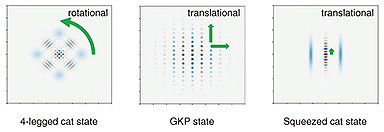
When a logical qubit is encoded using the many energy levels of a harmonic oscillator, symmetry becomes an important design principle. Symmetry means that a state remains unchanged under a set of operations. By using operations that leave the code states unchanged, we can more easily distinguish the states that should be protected from those that errors have taken outside the code space. In the next section, we explain how this symmetry can be used to design error-correction circuits. An important physical realization of a harmonic oscillator is an optical mode. In addition to being excellent for transmitting information, a single optical mode behaves as a harmonic oscillator with many energy levels, making it well suited to continuous-variable QEC. In other words, light can serve not only as a medium for carrying quantum information over long distances but also as a physical system in which quantum information can be protected from errors. NTT has pursued research and development in optical communications and optical devices for many years. By building on these strengths, we expect to make progress toward optical quantum computers and continuous-variable QEC that make full use of the properties of light. Continuous-variable QEC is an important approach for reducing hardware overhead as quantum computers are scaled up and for bringing us closer to practical quantum computation. 2. Error-correction protocol for squeezed cat codesA phase-space representation*1 is useful for intuitively understanding the symmetries of bosonic codes. The quantum state of a single optical mode can be represented on a plane, the two axes of which correspond to the cosine and sine quadratures of the electric field. The Wigner function makes it possible to visualize the shape and spread of a quantum state, although it is not an ordinary probability distribution. In this representation, the symmetries of bosonic codes can be observed directly (Fig. 2). In a 4-legged cat code, multiple peaks separated in phase space are interchanged by rotations about the origin. This rotational symmetry is connected with rules for distinguishing errors, such as the parity of energy levels [1]. In the Gottesman–Kitaev–Preskill (GKP) code [2], by contrast, peaks form a lattice and translational symmetry appears; the same arrangement is recovered after translation by a fixed distance. Bosonic codes based on translational symmetry have also been actively studied [3]. Thus, finding operations that leave code states unchanged provides a design principle for identifying the states to be protected and correcting errors that move a state away from the code space.
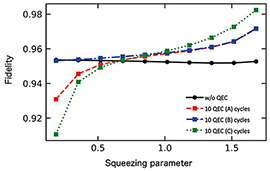
In conventional QEC, an ancillary qubit is measured to obtain information about an error, and a correction is then applied based on the measurement outcome. However, rapidly processing the measurement result and feeding it back into the control system makes the apparatus more complex and increases the time required for correction. This has motivated research on autonomous QEC, which requires neither measurement nor feedback. The basic idea is to engineer interactions with the environment that naturally return a state displaced from the code space by an error to the code space. Analogous to a warm object cooling by releasing heat to its environment, one engineers dissipation*2 so that unwanted excitations are removed from the system through dissipation into the environment. Symmetry is also useful when designing this dissipative process. We first identify a symmetry operation that leaves the code states invariant. From it, we then derive an operator that annihilates the code states. If this operator is used to engineer dissipation, the code states are preserved while components outside the code space are removed. Rather than directly creating a continuous interaction with an environment, researchers have proposed achieving the same dissipation using a discrete quantum circuit by repeatedly alternating short interactions between a bosonic mode and an ancillary qubit with initialization of the ancilla. For GKP codes, theoretical proposals for autonomous error correction based on this idea have been developed [4]. We applied this idea to the squeezed cat code [5]. A cat code is formed from a superposition of two states separated in phase space. In a squeezed cat code, squeezing is additionally applied to reduce quantum fluctuations along one direction in each state. This makes it possible to retain the cat code’s robustness against certain errors while partially detecting and correcting the effects of photon loss. We identified an operator associated with translational symmetry that exactly stabilizes finitely squeezed cat states. From this symmetry, we derived a dissipative mechanism that removes unwanted excitations while preserving the code states and constructed a corresponding autonomous QEC circuit. The circuit requires only conditional displacement operations, which move the state of the bosonic mode according to the state of an ancillary qubit, together with rotations and resets of the ancilla. These are standard operations in superconducting quantum circuits and trapped-ion systems, so the proposed scheme can reduce hardware overhead compared with previous proposals that require complex nonlinear interactions among multiple ancillary systems. Realizing the same conditional operations with high precision in optical systems remains an important challenge. In numerical simulations, we confirmed that repeatedly applying this QEC circuit after photon loss can improve the fidelity*3 of the encoded quantum information, with stronger squeezing leading to higher recovered fidelity (Fig. 3). We also showed that by interleaving the same error-correction step with computational operations, we can combine state preparation, one- and two-qubit logical operations, and logical-state readout to obtain the full set of operations needed for universal quantum computation. For logical-Z readout in particular, we designed a circuit that takes into account the error arising from finite squeezing and showed that it can achieve a substantially lower readout error than a simple readout method.
To clarify why our QEC circuit works, we used a theoretical framework called subsystem decomposition. A bosonic mode has an infinite-dimensional Hilbert space with infinitely many energy levels. In the subsystem picture, this space is decomposed into a logical degree of freedom, which carries the quantum information, and a gauge degree of freedom, which represents deviation from the code space. In this description, photon loss produces an error in the logical information while simultaneously leaving an excitation in the gauge degree of freedom. When our circuit removes one such gauge excitation, it simultaneously corrects the associated logical error. The resulting gauge excitation therefore serves as a detectable signature of the error, and dissipating this excitation constitutes the correction. This analysis also enables us to quantify how much excitation can be removed in a single QEC cycle and estimate how frequently the QEC circuit must be operated relative to the rate at which physical errors occur.
3. Future outlookWe used the symmetries of bosonic codes not only to classify quantum states but also to guide the joint design of error-correction circuits, logical operations, and readout. By extending our analysis to include errors in quantum operations and losses in experimental devices, we expect this approach to contribute to bosonic quantum computing that protects quantum information with fewer hardware resources. References
|
|||||||||||||||||