|
|||||||||||||||||||||
|
|
|||||||||||||||||||||
|
Feature Articles: Unraveling the Mind and Intelligence, and Weaving an Interconnected World Science of the Brain and Body behind Winning—Uncovering Neural and Physiological Mechanisms of Winning and Losing in EsportsAbstractIn top-level competitions where technical skills are evenly matched, mental strength often determines the winner. Although many studies have examined this strength, its neural basis remains unclear. Esports provides a useful setting for studying mental competition, combining split-second decision-making with psychological strategy. With minimal physical movement, it enables high-precision physiological monitoring in real-world settings, revealing core aspects of performance obscured by motor noise. Using neural, cardiac, and muscular signals recorded during gameplay, we at NTT Communication Science Laboratories identify brain activity that predicts outcomes and physiological states that distinguish experienced players from true elites. By analyzing these optimal states, we explore practical pathways to peak competitive performance. Keywords: esports, EEG, win/lose prediction  1. Mental strength in competition and esports as an experimental fieldAt the highest levels of competition, where competitors are evenly matched, technical skills often reach a plateau. Mental strength has therefore long been regarded as the decisive factor that ultimately determines who wins. However, science has yet to provide a sufficient account of what occurs in the brain and body of a mentally strong competitor. Sports neuroscience has focused on a phenomenon known as neural efficiency during superior performance [1]. This mechanism supports high performance by reducing the allocation of neural resources to unnecessary processing and making specific processes more efficient. Extending this knowledge could help us understand how people perform at their best under pressure in sport and other domains. It may eventually contribute to enhancing individual capabilities and improving quality of life. Yet previous studies have mainly used simple laboratory tasks under tightly controlled conditions. Because such tasks cannot fully reproduce the genuine tension of an actual competition, how this neural efficiency mechanism operates in real competitive settings has remained unclear. Researchers have attempted to overcome these limitations of laboratory studies by recording physiological activity during actual matches in real time, but these efforts have encountered another technical barrier. Large functional magnetic resonance imaging (fMRI)*1 scanners cannot be brought into competitive settings. Even portable electroencephalography (EEG) systems are affected by noise from vigorous whole-body movement, which can obscure subtle neural signals. Researchers have thus generally inferred internal brain states indirectly from measures that are less vulnerable to movement noise, such as gaze, heart rate (HR), and electromyography (EMG). To observe brain activity under the pressure of real competition, we at NTT Communication Science Laboratories turned to esports. Because body size and physical ability have less impact on outcomes in esports, the field is often characterized as a mental game that places a premium on sophisticated strategic exchanges and mental resilience. Its greatest advantage for research is that it involves little vigorous whole-body movement and concentrates motor output in the hands. This makes it possible to record high-quality EEG signals directly during genuine matches while keeping movement noise to a minimum. By combining the ease of physiological recording with the tension of competition, esports can provide an ideal experimental environment for revealing essential features of competitive performance that are often obscured by movement noise. We have used this advantage to pursue three research themes: the relationship between brain states immediately before a match and its outcome, optimization of motor output at critical moments, and physiological synchrony between opponents.
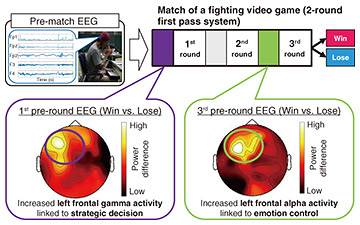
2. Brain states immediately before a match and their relationship with match outcomesPrevious studies have linked EEG activity to performance in individual actions, such as a basketball free throw. However, it was unknown whether EEG could predict the outcome of an actual match that unfolds over an extended period and contains many uncertain elements. We studied fighting video games*2, which are played competitively in esports and are well suited to EEG recording. We focused on the period immediately before each round, when players develop strategies and prepare themselves mentally [2]. We analyzed EEG data recorded immediately before each round in matches in which victory required winning two rounds (Fig. 1). The results indicate that players who eventually won switched skillfully between different brain states as the match progressed. Immediately before the first round, players who later won showed a significant increase in gamma oscillations*3 over the left frontal region, an area associated with strategic decision-making. Questionnaire responses also indicate that the increase in gamma oscillations was more pronounced among players who felt that they had formulated their strategy successfully before the round. These findings suggest that allocating neural resources to decision-making is especially beneficial early in a match.
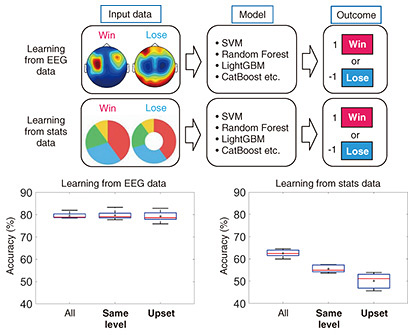
By contrast, immediately before the deciding round, when the score was tied at one round each, alpha oscillations*4 in the same region were significantly greater in eventual winners. Increased left frontal alpha activity is known to be associated with the regulation of negative emotions such as anxiety. The questionnaire results likewise indicate that players were more successful at controlling anxiety during the later stages of matches that they won. These findings suggest that winning players can regulate their emotions effectively under pressure late in a match, which may help them perform at their usual level in the final round. We next asked whether match outcomes could be predicted solely from EEG recorded before play began [3]. In short matches in which victory required winning one round, we constructed machine-learning models using EEG data from immediately before each round as input and the subsequent win or loss as the target label. The best model predicted match outcomes from EEG recorded before the round with an accuracy of approximately 80% (Fig. 2).
The model achieved similar accuracy in closely matched contests and in contests that ended in an upset. Conventional methods based on past records and game statistics can fall to near-chance level, approximately 50%, when a match defies prior expectations. Our EEG model, however, maintained high accuracy. This suggests that the condition of the brain at the very moment a player is about to compete may impact the outcome more strongly than past performance does.
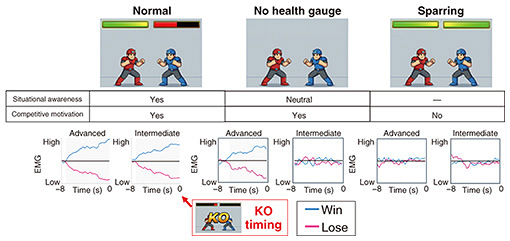
3. Motor control by advanced players at critical momentsMost conventional studies of motor control have examined repetitive movements or responses to simple visual stimuli. In real competition against another person, however, athletes must continually adjust their motor control as the situation changes from moment to moment. Findings from conventional laboratory tasks alone therefore cannot fully explain how athletes control their bodies in competition. In particular, the effects of factors specific to competition, including skill level, limited information, and strong competitive motivation, on motor output remain poorly understood. To clarify how motor control differs with skill level and how it is shaped by task context, we examined arm-muscle activity during critical moments near the end of esports matches. We manipulated how easily players could assess the match state and their motivation to win through three experimental conditions. These were normal competition, competition without visible health gauges, and sparring. We then compared arm-muscle activity and controller performance between advanced and intermediate players, as shown in Fig. 3 [4].
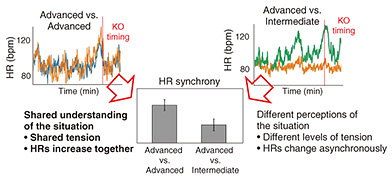
In normal competition, players can easily understand the match state from the health gauges, and standard rules help maintain strong competitive motivation. When the health gauges are hidden, it becomes more difficult to determine which player has the advantage. During sparring, neither player loses health, no advantage or disadvantage emerges, and the round has no winner. We therefore expected this condition to make competitive motivation difficult to maintain. Analysis of muscle activity during play showed that, in normal competition, winners gradually increased the intensity of arm-muscle activity beginning approximately eight seconds before the end of the round and executed commands on the controller more rapidly. Losers, by contrast, showed decreasing muscle activity. This pattern suggests that psychological hesitation may be expressed as reduced motor output. Differences related to skill level were especially clear when the health gauges were hidden. Intermediate players could no longer be certain that a critical moment had arrived once this visual information was removed. As a result, the increase in muscle activity and faster controller inputs observed just before the end of a round disappeared completely. Advanced players, however, increased arm-muscle activity and controller input speed at the same stage of the round as during normal competition. In doing so, they shifted into a state that was more favorable for winning even without visible health gauges. Under the sparring condition, which had no winner or loser, this increase in muscle activity did not occur at either skill level. These results suggest that intermediate players adjust motor output reactively and depend on external visual information. Advanced players, by contrast, may use internal models constructed through extensive experience to predict future developments with high precision. This ability may enable them to anticipate critical moments and prepare the motor output that will soon be required. 4. Physiological synchrony between advanced players during competitionIn addition to changes that occur within an individual, we examined physiological interactions between two opponents. It is widely known that physiological dynamics, such as changes in HR, can spontaneously align between people who have a close psychological relationship or who work together. Physiological synchrony was therefore traditionally thought to occur specifically in situations involving empathy or positive cooperation. Recent work from our group, however, showed that HR synchrony can emerge between esports players even when they oppose each other in competition [5]. The ability to become physiologically coupled with an opponent during competition may be closely related to a player’s mental skills. We therefore investigated the specific conditions under which HR synchrony becomes especially strong during competition [6]. We recorded electrocardiograms during matches under the three conditions described above. Strong HR synchrony between opponents emerged during normal competition only in matches between two advanced players (Fig. 4). When two advanced players competed without visible health gauges, synchrony remained high even though the match state was difficult to assess. It fell sharply, however, when they switched to sparring with no winner or loser. These findings indicate that the heart rhythms of two players synchronize strongly only when both are highly skilled and share a strong motivation not to lose.
The key to this mechanism may be whether both players assign the same importance to the same critical moments at the same time. Because advanced players have a deep understanding of the game system, established tactical patterns, and their opponent’s intentions, they are more likely to recognize the same moments of rapidly rising tension and the same brief opportunities to initiate an attack. Their HRs consequently increase with similar dynamics. The ability to synchronize closely with an opponent at the physiological level may be a sign of the strength that advanced players acquire through years of practice. 5. New possibilities for performance research revealed in real competitive settingsTaken together, these studies have begun to reveal through objective data the nature of abilities that traditional sports coaching has often grouped under the vague label of mental strength. As a practical form of mental training based on these findings, we plan to develop a system that provides users with feedback on their own EEG data in real time and helps them voluntarily create a brain state associated with a greater likelihood of winning. We are also considering scientifically grounded coaching that monitors physiological measures and is tailored to each athlete’s level of expertise. These insights into brain and body control may also be applied to high-pressure settings in the real world. Examples include medical settings such as surgery, where a momentary error in judgment can threaten life, high-risk construction work, and important presentations. Our goal is to apply this knowledge by developing environments and devices that help people regulate their brains and bodies optimally and perform reliably during tasks that impose intense stress. 6. ConclusionNeuroscience has developed largely through carefully controlled laboratory tasks. Yet many situations in which people must perform at their best arise in real-world tasks that involve intense tension and strong motivation. We see great potential in esports as an ideal field for bridging the gap between laboratory research and actual performance settings. We will continue this research to clarify the mechanisms of the brain and body that enable people to maximize their abilities under pressure. References
|
|||||||||||||||||||||