|
|||||||||||||||||||||
|
|
|||||||||||||||||||||
|
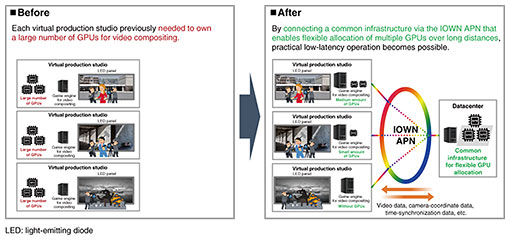
Feature Articles: Technology Development Trends of the IOWN 2.0 Era—From Communications to Computing Vol. 24, No. 4, pp. 14–21, Apr. 2026. https://doi.org/10.53829/ntr202604fa1 Initiatives toward Social Implementation in the IOWN 2.0 EraAbstractThis article introduces trends in the technological development of the Innovative Optical and Wireless Network (IOWN) 2.0 era along with its benefits on the basis of knowledge gained through initiatives such as use-case development and demonstrations and customer needs. It also introduces application use cases now being studied at NTT IOWN Product Design Center. Keywords: APN, DCI, demonstration  1. IntroductionThe Innovative Optical and Wireless Network (IOWN) is a next-generation information and communications infrastructure centered on photonics. By applying photonics-electronics convergence (PEC) devices across multiple domains and extending optical technologies from end-to-end networking into the interior of computers, IOWN aims to renew system architectures and significantly improve energy efficiency. The IOWN roadmap envisions staged technical progress—IOWN 1.0, IOWN 2.0, IOWN 3.0, and IOWN 4.0—driven by advances in the key PEC devices [1]. The first practical deployment, IOWN 1.0, uses PEC devices for relatively long-distance links (PEC-1) such as inter-exchange and inter-datacenter connections. In 2023, NTT EAST and NTT WEST released a commercial service called All-Photonics Network (APN) IOWN 1.0, delivering high speed, large capacity, and low latency. Building on that, IOWN 2.0 targets the computing domain by using PEC devices optimized for short-reach, high-capacity, and low-power board-to-board connections (PEC-2). This will enable practical Data-Centric Infrastructure (DCI) as a computing system that leverages PEC-2. In the IOWN 2.0 era, the combination of the APN for communications (from IOWN 1.0) and DCI for computing (from IOWN 2.0), together referred to as IOWN optical computing, will broaden IOWN’s potential. This article describes the APN enhancements required for IOWN 2.0, introduces DCI, and outlines efforts by NTT IOWN Product Design Center toward integrating DCI and the APN into IOWN optical computing. 2. The commercial APN now being providedA variety of research and development (R&D) efforts are being made regarding the APN with the aim of achieving a 2030 target performance (100 times power efficiency, 125 times transmission capacity, 1/200 end-to-end latency), and following the initial launch of APN IOWN 1.0, NTT EAST and NTT WEST began providing “All-Photonics Connect powered by IOWN” toward further improvements in convenience based on customer opinions and R&D results [2, 3]. In addition to the high-speed, large-capacity, low-latency, and zero-jitter features of APN IOWN 1.0, All-Photonics Connect powered by IOWN features the following three functions: (1) supports a maximum bandwidth of 800 Gbit/s, the world’s highest standard, as bandwidth-guarantee communications between user sites, (2) provides a wide-area service capable of point-to-point connections between any two points within the covered area, (3) supports Ethernet interfaces at 100 and 400 Gbit/s and saves space and reduces power consumption at customer sites by installing circuit-terminating equipment within NTT communication buildings. NTT DOCOMO BUSINESS also began providing “APN leased line plan powered by IOWN” in March 2024 as a network service spanning prefectures to support advanced customer needs in communication infrastructures [4]. In October 2025, it then integrated this service into “docomo business APN Plus powered by IOWN,” and through functional enhancements, such as adding a circuit menu enabling on-demand bandwidth changes and augmenting a wideband menu, expanded this into a core service supporting the concept of the AI-Centric ICT (information and communication technology) Platform applicable to the artificial intelligence (AI) era [5]. 3. Main use cases in the current APNThe use of the APN in business is expanding in both Japan and overseas in a variety of industries. 3.1 Application to the broadcasting industryThe need for more efficient video production and digital transformation (DX) has been growing because competition has been intensifying due to increasing demand for digital media services. To support live broadcasts with a high-realistic video from remote locations such as sports and concert venue, broadcasting stations face issues to possess expensive broadcasting vehicles and a large on-site staff with long working hours. Connecting between a variety of shooting locations and production sites with the large-capacity and low-latency APN enables a video production DX that can produce high-quality content in real time without on-site vehicles and a large staff. At NTT R&D Forum held in November 2025, remotely distributed graphics processing units (GPUs) were connected via the IOWN APN to demonstrate a virtual production technique as one example of a video production DX. NTT showed high-quality video production that could be achieved with low latency without a permanent installation of high-performance equipment at production sites [6] (Fig. 1).
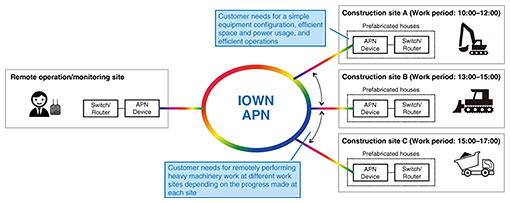
3.2 Application to the construction and manufacturing industriesIn the construction and manufacturing industries, an urgent need has arisen for DX and other measures in the face of work-style reforms (e.g., overtime cap) and labor shortages. Studies are therefore being conducted to achieve radical improvements in work efficiency through operation of machinery and centralized management from remote locations. At NTT R&D Forum held in November 2023, NTT demonstrated remote operation of a hydraulic excavator installed in the field in Chiba Prefecture and a tower crane installed in the field in Osaka from a cockpit in NTT Musashino R&D Center in Tokyo [7]. We achieved equivalent operability comparable to on-site operation of those heavy machineries with only several-millisecond latency by using the APN between Tokyo and Osaka, a distance of over 500 km. The IOWN Global Forum organized the documentation for use cases of remote and automated construction management in mountain tunnels and discusses the use of the APN for remote monitoring, remote analysis, remote inspection, and remote maintenance [8]. At NTT R&D Forum held in November 2025, we then held a demonstration on AI-based visual inspection via the APN between a factory and datacenter separated by 300 km and showed that this technology could be used to establish unified quality standards and improve productivity. We also confirmed that remote control of production facilities could be executed within a control period of 20 milliseconds by a cloud-shifted controller. This result is expected to lead to reducing on-site working hours and improving productivity across multiple factories. 3.3 Application to datacenter connectionThe securing of land for datacenters in urban areas has increasingly become difficult; therefore, there is an urgent need to secure suburban land and electric power for datacenters. Against this background, movements to maximize power consumption efficiency through flexible use of renewable energy and the expansion of the ICT infrastructure are accelerating on the basis of the concept of watt-bit collaboration, which aims to encourage the effective collaboration between electricity and telecommunications entities. Efficient computational processing that uses regional renewable energy can be achieved by connecting datacenters spanning different areas, as in connections between datacenters in urban and suburban areas. This will enable advanced distributed processing using high-speed, large-capacity, and low-latency connections with the APN. 4. APN evolutionWe have implemented use cases with customers in various industries to solve their specific problems. Through these opportunities, we are accelerating APN development with customer feedback and expectations for more flexible use of the APN. 4.1 Customer expectations for the APNIn the broadcasting industry, when companies proceed video production DX for live sports broadcast, they need flexible connection of the APN to a variety of stadiums based on the type of sports, such as baseball and soccer. They pursue reducing facility-usage costs with the minimum time needed for pre- and post-event preparation for broadcasting; therefore, the APN also must achieve on-demand connectivity for video production DX. When the video-production studio and equipment are being shared by several companies, the efficient allocation of computing resources, such as GPUs, is also necessary based on the usage conditions of each company. In the construction industry, the need has been expressed for executing heavy machinery work remotely at different construction sites in the morning and afternoon. Since the location at which the customer would like to use the APN will change in a short period, there is a need for on-demand use of the APN. On-site offices, such as prefabricated houses in many cases, are frequently used as locations to install the network equipment. Because of the limitation of the available space and power capacity, on-site workers expect to use such resources effectively with simple configurations (Fig. 2). With the expansion of remote and automatic construction, AI for danger predictions or the other functions will be available in on-site work by using the connection to computing resources for AI processing.
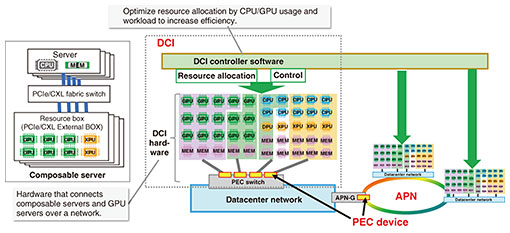
4.2 APN technology developmentAs we expand and diversify APN-application use cases, there will be a need to develop additional functions that contribute to enhanced customer convenience. The open converged transponder (OCT) is being studied as a technology for making the devices that use the APN more compact and fewer in number and for lowering power consumption. It is expected that equipment cost, power consumption, and installation space can be reduced though equipment integration by developing optical transceivers with a pluggable-module format and mounting some of the Layer 1 transmission functions in Layer 2/3 equipment such as switches and routers. Development of an APN controller (APN-C) is also progressing for achieving control, operation, and intelligent functions for APN provision. It will execute multi-vendor device control including the above OCT. The APN-C features functions that enable the sharing of limited wavelength resources and efficient design of routes and wavelengths. The aim is to provide a service that can flexibly change APN connection points by switching optical paths in an on-demand manner of tens of minutes. We are also researching and developing a wide range of technologies including wavelength-conversion technology to support a variety of connections using wavelengths, automatic optical-path provisioning technology that can contribute to shortening delivery times from the viewpoint of accelerating global expansion, and 1.6-Tbit/s optical transmission technology for achieving further increases in capacity. 5. From communications to computing: IOWN 2.0 and DCIBuilding on the APN and IOWN 1.0, IOWN 2.0 will bring photonics into the computing domain. A new technology class, DCI, uses PEC-2 devices to interconnect computer resources and reduce power consumption. In IOWN 2.0, the APN’s communications and DCI’s computing capabilities will combine into IOWN optical computing, which refers to architectures that use PEC-based optical technologies for data movement. This combination will expand the IOWN ecosystem. 6. What DCI aims to achieveDCI improves power and cost efficiency by increasing utilization of compute resources—central processing units (CPUs), GPUs, memory, and storage—through high-bandwidth and low-latency interconnects. Following a data-centric philosophy (focusing on where data are generated, stored, and used), DCI optimizes disaggregation and interconnection of compute and storage resources to increase overall resource efficiency. When achieved with PEC devices and low-latency APN links, this approach is what we call IOWN optical computing, as illustrated in Fig. 3.
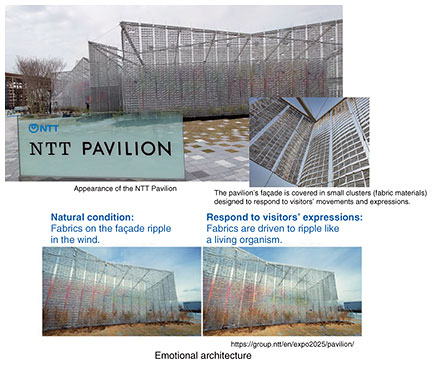
DCI is moving from concept to practice through active proofs of concept and demonstrations. One notable field trial took place at the Expo 2025 Osaka, Kansai, Japan, where the APN connected the venue to a datacenter running DCI, demonstrating practical IOWN optical computing services. The following sections summarize the DCI building blocks and the Expo results. 7. Enabling technologies for DCIDCI consists of network-connected hardware, such as composable servers, GPU servers, and a DCI controller that optimally assigns the interconnected CPU/GPU resources. The key components are explained as follows. 7.1 Composable serversTraditional servers package CPU, GPU, memory, and storage together in a single chassis. Composable servers instead use servers that host CPUs, boxes that host multiple GPUs or storage devices, and boxes with compute express link (CXL) memory modules; these boxes are interconnected via Peripheral Component Interconnect Express (PCIe) or CXL fabric switches. This architecture allows for flexible combinations of CPU, GPU, storage, and CXL memory to match workload requirements. For example, in a conventional server with one CPU and four GPUs, two GPUs might be unused if a user needs only two GPUs; composable servers reduce such waste by enabling more flexible allocation of GPUs and memory to CPUs. For more detail, see the article “Initiatives toward Multiple Vendor-sourced Composable Servers in DCI Technology Development” [9] in this issue. 7.2 PEC-2A high-performance data network that efficiently connects many servers is important for DCI. AI datacenters require a large inter-server bandwidth as multiple GPU servers collaborate and exchange massive amounts of data, often leading to servers being equipped with multiple network interface cards and a rapid increase in network port counts. The cost and power consumption of networking equipment have thus become significant, increasing demand for higher-capacity and lower-power network switches. A PEC device enables large-capacity, low-power switches. A PEC device can improve the capacity and power efficiency of optical transceivers that execute the electrical-to-optical and optical-to-electrical conversions in network switches. In the Expo demonstration, we used a PEC-2 device compliant with OIF (Optical Internetworking Forum) standards. It delivered a 3.2-Tbit/s per module, eight times the throughput of a 400-Gbit/s transceiver, demonstrating a major leap in per module capacity. This PEC-2 device reduced power per bandwidth to roughly half that of conventional transceivers, making it a key technology for large, low-power network switches required by AI datacenters. While the PEC-2 device used at the Expo 2025 operated at 3.2 Tbit/s, an improved PEC-2 device with 6.4-Tbit/s capacity is currently under development. For more detail, see the article “A High-capacity, Energy-efficient Photonics-electronics Converged Switch with PEC-2” [10] in this issue. 7.3 DCI controllerA key element of IOWN optical computing is the DCI controller, which integrates and controls the components described above. The DCI controller can allocate compute resources while accounting for resource and power conditions across multiple datacenters. It consists of application frameworks and a dynamic hardware resource controller (DHRC). The application frameworks provide well-tuned software templates so applications can efficiently use DCI resources. When an application runs on DCI, the DHRC allocates optimal resources on the basis of current resource utilization and workload characteristics. These components increase resource-utilization efficiency and reduce cost and power consumption. 8. IOWN 2.0 service exampleDuring Expo 2025 held on Yumeshima in Osaka from April 13 to October 13 (184 days), NTT exhibited a pavilion titled “Parallel Travel,” which enabled visitors to experience a journey across space and time through advanced communication technologies. By connecting the NTT Pavilion and a remote datacenter via the APN and using DCI installed in the datacenter to provide services at the pavilion, we demonstrated the concept of IOWN optical computing. The DCI-based services provided at the NTT Pavilion were as follows.
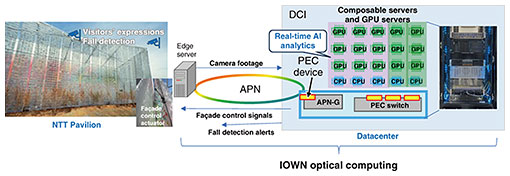
9. System architecture used at the ExpoFigure 5 shows a schematic of the system used at the Expo. Because it was difficult to secure sufficient server space and power inside the pavilion, we installed only small, low-power servers on site and executed power hungry AI analytics on servers located in a datacenter in Osaka with sufficient power and space, several tens of kilometers from the pavilion.
At the pavilion, edge servers collected camera footage and sent it to the datacenter over the APN. The datacenter hosted composable servers and GPU servers with multiple GPUs; GPUs were allocated appropriately to the facial expression analysis and fall detection applications. Incoming data were routed through a network switch (PEC switch), which consumes less power than a conventional switch, and distributed to the appropriate GPUs for AI analytics. The analytics results were returned to the pavilion as façade control signals, and notifications (e.g., fall detection alerts) were issued as needed. By connecting the pavilion to a remote datacenter over the APN and allocating GPUs on servers, which were connected by the PEC switch for each application, we demonstrated a concrete implementation of IOWN optical computing. This configuration achieved better GPU utilization and lower power consumption than conventional setups, enabling continuous real service operation throughout the 184-day Expo and contributing to the pavilion’s success. 10. Future outlookThis article described examples of APN deployments launched under IOWN 1.0, the customer expectations that emerged from those deployments, and an overview of APN technology development trends aimed at future needs. It also explained the technologies that underpin DCI for IOWN 2.0 and presented an implementation example from the Expo 2025 that demonstrated IOWN optical computing by explicitly combining DCI-based computing with APN-based communications. Going forward, we will contribute to the social implementation of IOWN 2.0 through continued practical demonstrations and trials that advance the maturity and deployment readiness of both the APN and DCI. References
|
|||||||||||||||||||||