|
|||||||
|
|
|||||||
        |
Global Standardization Activities Vol. 24, No. 3, pp. 50–54, Mar. 2026. https://doi.org/10.53829/ntr202603gls Latest Trends toward the 2027 ITU World Radiocommunication Conference (WRC-27)AbstractThe World Radiocommunication Conference (WRC), organized by the International Telecommunication Union (ITU), is an international conference primarily aimed at revising the Radio Regulations (RR), which is the set of international rules governing radiocommunication. The next conference is scheduled for 2027, but discussions for preliminary studies and consensus-building are already in a full-scale phase within ITU-R (ITU Radiocommunication Sector) Study Groups, regional groups, and individual countries. Since the amendments to the RR are reflected in domestic radio laws and regulations, this conference is extremely important for NTT Group, which provides various wireless services such as mobile phones. This article provides an overview of the main agenda items and current state of discussions for WRC-27. Keywords: ITU-R, World Radiocommunication Conference, Radio Regulations
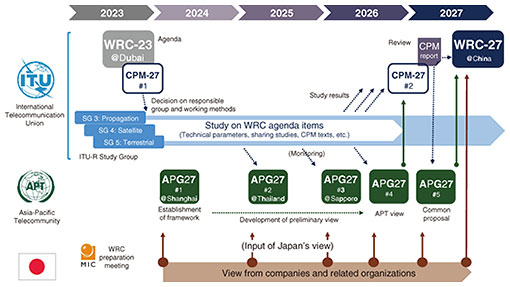
1. World Radiocommunication Conference and related meetingsThe World Radiocommunication Conference (WRC) is usually held every four years to deliberate on the use of radio frequencies, satellite orbits, and the operation of radio stations in each frequency band. The decisions are reflected in the Radio Regulations (RR), which has the force of international law and is incorporated into the domestic laws of each country. The RR has a significant impact on future radio utilization policies, so a wide range of stakeholders—including government agencies, telecommunications and broadcasting operators, equipment vendors, and research institutions in the radio field—participate in the conference. At the previous WRC-23 held in Dubai in 2023, about 3900 participants from 163 member countries attended. Japan sent a delegation of about 130 people from the Ministry of Internal Affairs and Communications, private companies, and related organizations. NTT Group, including NTT and NTT DOCOMO, participated as part of the Japanese delegation and contributed to discussions such as the identification of the 7025–7125-MHz band for fifth-generation mobile communication systems (5G)/6G use [1]. The agenda for the next WRC is also discussed at each WRC, and the agenda for WRC-27 was decided at WRC-23. Preparatory studies and deliberations for these agenda items are carried out over three to four years until the next WRC. To facilitate this process, Conference Preparatory Meetings (CPMs) are held. The first CPM is held immediately after the WRC to decide on the work schedule and the responsible International Telecommunication Union Radiocommunication Sector (ITU-R) Study Groups (SGs) for each agenda item. The second CPM is held about six months before the WRC to finalize the CPM Report, which summarizes the results of preparatory studies and options for revising the RR. Each country and regional group refers to the CPM Report to formulate their positions and proposals, which are then discussed at the WRC. Each Working Party (WP) of ITU-R SGs is currently proceeding with studies according to the responsibilities decided at the first CPM. As of December 2025, the technical and operational parameters for each radio service/system have been collected for sharing studies, and research on sharing possibilities and conditions is in a full-scale phase. In parallel with ITU-R studies, preparatory meetings are regularly held at the level of six regional groups worldwide to promote consensus-building and develop their regional common proposals. Japan belongs to the Asia-Pacific Telecommunity (APT), and the second APT Conference Preparatory Meeting for WRC-27 (APG-27) was held at the end of July 2025. There, provisional regional views were discussed, and consensus documents were compiled. The next APG meeting is scheduled for July 2026 in Sapporo, Japan. In Japan, the Ministry of Internal Affairs and Communications has established and operates a WRC-related liaison meeting, where stakeholders from companies and industry groups in each radio utilization field gather to deliberate on policy directions and contribution documents for APG and WRC meetings. NTT participates through its Technology Planning Department (Radio Division) and NTT Access Network Service Systems Laboratories (Fig. 1).
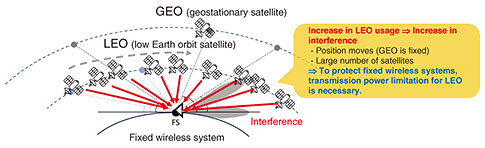
2. WRC-27 agendaAt WRC-23, more than 30 proposal documents were submitted by regional groups and countries, and the agenda was decided after intense deliberations [2]. Reflecting the recent evolution and diversification of wireless technologies and the expansion of new wireless uses across land, sea, air, and space, these agenda items cover a wide range of topics. Many of the frequency bands involved are already densely used, and there are many stakeholders; thus, much time was spent on deliberations regarding which radio services to share and the selection of specific frequency bands. The following are the main agenda items related to NTT Group’s business. 2.1 Protection of 70/80-GHz fixed wireless systems (agenda item 1.10)With the consideration of introducing mobile satellite services using low Earth orbit (LEO) satellites in the 71–76- and 81–86-GHz bands, this agenda item aims to examine measures to protect fixed and mobile services in these bands. Since the 70/80-GHz fixed wireless systems are used as backhaul lines by NTT Group in Japan, it is necessary to ensure their protection. 2.2 Mid-band use for 6G/IOWN (agenda item 1.7)The expansion of frequency bands for mobile phones continues to attract global attention and has been on the agenda at every WRC since WRC-15. At WRC-23, many proposals focused on the mid-band (7–15 GHz) for further development of 5G and the introduction of 6G. As a result, the 7125–8400-MHz and 14.8–15.35-GHz bands were agreed upon as targets, and the 4400–4800-MHz band, already used for mobile phones in Japan, was also included. 2.3 Non-geostationary satellite-related issues (agenda items 1.5 and 1.13)Since the 2020s, communication services using non-geostationary satellites, especially LEO satellite constellations like Starlink, have become widespread globally. NTT Group is also collaborating with Amazon for domestic introduction in 2026. However, unauthorized operations of such non-geostationary satellite services have become a concern, and necessary regulatory measures are being discussed (agenda item 1.5). In Japan, direct communication services between LEO satellites and smartphones began in April 2025, but such use of mobile phone frequencies for direct satellite-smartphone communication is not assumed in the RR. Therefore, discussions were held on the basis of proposals from Japan, China, and others, and it was agreed to discuss new allocations to the mobile satellite service for the 694-MHz–2.7-GHz mobile phone frequencies, with discussions to be held on conditions to protect neighboring countries’ radio services (agenda item 1.13). 3. Latest status of main agenda itemsThe deadline for ITU-R studies on WRC-27 agenda items is set for October 2026, and as of December 2025, studies are still ongoing. Below is the status of main agenda items related to NTT Group business at ITU-R SGs and APG meetings: 3.1 Protection of 70/80-GHz fixed wireless systems (agenda item 1.10)This agenda item is being studied mainly by SG 5 WP 5C, responsible for fixed wireless systems at ITU-R. The aim is to determine appropriate limits to protect fixed wireless systems from the expected increase in LEO satellite use in the 70/80-GHz bands, as there are currently no transmission power limits. Technical information on satellite systems is being collected, and working documents are being prepared. At the May 2025 meeting, short-term protection criteria for fixed services were agreed upon, and at the November 2025 meeting, discussions were held on propagation environments, antenna elevation angles, antenna characteristics, the number of satellites to consider, and need for coordination between satellite earth stations and fixed wireless stations. Further sharing studies will be conducted at the next meeting. At the APG27-2 meeting, it was agreed to continue supporting ITU-R studies, and their situation is being closely monitored. Notably, the drafting group chair for this agenda at APG is Shinya Otsuki of NTT Access Network Service Systems Laboratories (Fig. 2).
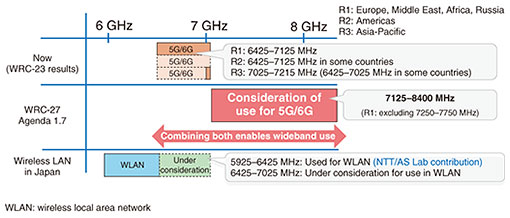
3.2 Mid-band use for 6G/IOWN (agenda item 1.7)This agenda item is being studied mainly by SG 5 WP 5D (Chair: Hiroyuki Atarashi, NTT DOCOMO) at ITU-R, responsible for mobile systems. Initial work involved organizing technical and operational characteristics by frequency band, and sharing studies with other radio services in each band (4.4–4.8 GHz, 7.125–8.4 GHz, 14.8–15.35 GHz) are now in full swing. There are divided opinions between those promoting mobile use and those prioritizing protection of existing services, and work continues to organize and compare the results of sharing studies. At the APG27-2 meeting, Japan and Korea submitted opinions in favor of mobile use, while China and others opposed, citing the need to protect existing services. Agreement was reached only to continue supporting ITU-R studies. The 7–8-GHz band, being lower in the mid-band and allowing for a wide allocation when combined with the adjacent 6-GHz band, is attracting attention both internationally and domestically (Fig. 3).
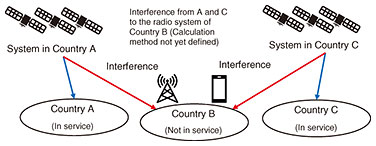
3.3 Non-geostationary satellite-related issues (agenda items 1.5 and 1.13)Agenda item 1.5 (regulatory measures for unauthorized operation of non-geostationary satellites in other countries’ territories) is being studied mainly by SG 4 WP 4A, responsible for fixed satellite services at ITU-R. Basic discussions on regulatory approaches continue, with issues such as identifying the responsible authority and concerns about responsibility being divided among multiple authorities. At the APG-27 meeting, there was agreement on the need to stop unauthorized terminals, but opinions were divided between Japan and others, who believe the existing framework is sufficient, and countries advocating for mandatory operation suspension. Agenda item 1.13 (direct communication between satellites and smartphones) is being studied mainly by SG 4 WP 4C, responsible for mobile satellite services. The list of frequency bands to be studied has been finalized, and related groups have been notified. Further discussions are needed on system functions, operational images, technical parameters, interference management, cross-border operations, and authorization issues. SG 5 WP 5D on the mobile phone side is also considering interference definitions and protection methods for terrestrial systems in foreign territory. At the APG-27 meeting, as with agenda item 1.5, many issues were raised, such as how to deal with unauthorized terminals and how to calculate interference from multiple systems, and agreement was reached only to continue supporting ITU-R studies (Fig. 4).
4. Future plansNTT Group will continue to actively contribute to ITU-R, regional meetings in the Asia-Pacific, and related domestic meetings toward WRC-27. References
|
||||||