|
|||||||||||||||
|
|
|||||||||||||||
        |
Regular Articles Vol. 24, No. 3, pp. 41–49, Mar. 2026. https://doi.org/10.53829/ntr202603ra1 Cavity Optomechanics Using Fiber-type Microbottle ResonatorsAbstractFiber-type microbottle resonators are tiny glass “bottles” formed on standard optical fibers, with diameters comparable to that of a human hair, that confine both light and mechanical vibrations that interact with each other via radiation pressure. This optomechanical interaction enables ultrasensitive readout of the mechanical displacement using strongly confined light. A key feature of microbottle resonators is that their mechanical modes can be naturally scaled from a single resonator to extended optomechanical arrays. This multimode capability enables highly sensitive mass and liquid-level measurements, as well as controlled synchronization with novel topological structures in phase space, pointing toward ultrasensitive biochemical sensing and energy-efficient neuromorphic information processing. This article reviews recent progress in cavity optomechanics based on fiber-type microbottle resonators, mainly focusing on our recent work. Keywords: cavity optomechanics, optomechanical resonators, nanomechanics
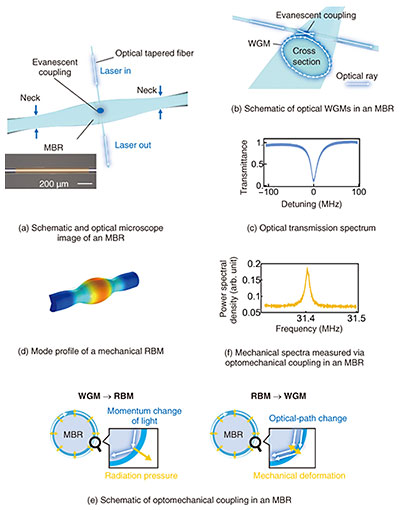
1. IntroductionCavity optomechanics explores the interaction between strongly confined light and mechanical motion via radiation pressure. Following the emergence of cavity optomechanics in the mid-2000s, this field has enabled a wide range of fundamental studies and applications, including laser cooling of mechanical resonators toward the quantum ground state, ultraprecise displacement and force sensing, wavelength conversion between distinct optical bands, and experimental demonstrations of nonlinear, nonequilibrium, and topological physics. A central challenge in this field is to develop optomechanical platforms that simultaneously offer strong light–matter interaction, scalability to multiple mechanical modes, and compatibility with complex environments such as liquids. Optical whispering-gallery-mode (WGM) microresonators constitute one of the most successful platforms for cavity optomechanics because of their ultrahigh optical quality (Q) factors, small mode volumes, and efficient fiber-based coupling schemes. However, many conventional WGM devices—such as microtoroids, microspheres, and microdisks—are essentially zero-dimensional objects, in which scaling to multiple mechanically coupled modes or extended architectures requires additional design complexity and often compromises performance. Fiber-type microbottle resonators overcome these limitations by introducing a smooth axial curvature along a standard optical fiber, which provides an additional spatial degree of freedom for both optical and mechanical modes. This unique geometry naturally supports multiple axial mechanical modes with well-defined spatial overlap, while preserving ultrahigh-Q optical WGMs under ambient conditions. Because microbottle resonators are directly fabricated on silica fibers, they combine the advantages of solid-state optomechanical resonators with the flexibility, robustness, and environmental accessibility of fiber-optic systems. Microbottle resonators thus offer a rare combination of features: scalable multimode optomechanics within a single resonator; straightforward extension to mechanically coupled arrays along a single fiber; and compatibility with operation in air, liquid, and at air–liquid interfaces. These characteristics make microbottle resonators particularly well suited for exploring cavity optomechanics beyond single-mode systems, including vibration transport, liquid-phase sensing, synchronization phenomena, and engineered nonlinear dynamics. In contrast to many optomechanical platforms, these capabilities are achieved within a single, unified device architecture, rather than through separate or highly specialized designs. This article reviews recent progress in cavity optomechanics based on fiber-type microbottle resonators, mainly focusing on our recent work. Section 2 introduces the fundamentals of optomechanics in microbottle resonators, including their fabrication and optomechanical properties [1]. Section 3 describes a mechanically coupled optomechanical array—the chained microbottle resonator—fabricated on a single optical fiber, which enables vibration transport in a fiber-based platform [2]. Section 4 focuses on liquid optomechanics using twin-microbottle resonators, where we demonstrate free-access liquid probing [3] and its extensions to mass [4] and liquid-level sensing [5]. In Section 5, we present synchronization between two mechanical modes via optomechanical coupling and engineered dynamics using an intensity-modulation technique [6]. Finally, Section 6 summarizes the key features of microbottle-resonator-based optomechanics and discusses prospects toward sensing, nonlinear dynamics, and complex optomechanical networks. 2. Fiber-type microbottle resonators: FundamentalsA schematic of a fiber-type microbottle resonator is depicted in Fig. 1(a). The resonator is fabricated on a silica glass fiber using a heat-and-pull technique as follows. (1) The silica fiber is locally heated close to the glass-melting temperature using a graphite heater. (2) A neck structure is formed by pulling both ends of the fiber with an appropriate tension. (3) A bottle-shaped structure is then formed between the two necks by repeating the above process at different heating positions. Because silica glass exhibits ultrahigh transmittance in the telecommunication band and the fabrication process yields a smooth surface, this structure supports ultralow-loss optical modes, referred to as optical WGMs. The optical WGMs can be intuitively understood as cavity modes in which light circulates around the cross section of the microbottle resonator via total internal reflection (see Fig. 1(b)). In addition to this circulating nature, the microbottle resonator provides three-dimensional confinement of light: the smooth curvature along the axial direction acts as an effective “potential” that confines the light axially. To guide laser light into these WGMs, evanescent optical coupling from a tapered optical fiber is used, where the fiber radius is adiabatically reduced to be on the order of the optical wavelength (see Fig. 1(a)). The same tapered fiber also collects the output light from the cavity, so a transmission spectrum is obtained by scanning the laser frequency (see Fig. 1(c)). From the linewidth of the transmission dips, the optical Q factor, which characterizes how strongly light is confined inside the cavity, typically reaches 107–108, much higher than those of semiconductor ring cavities and photonic-crystal cavities. The microbottle resonator operates not only as an ultrahigh-Q optical cavity but also as a high-Q mechanical resonator under ambient pressure and at room temperature. Similar to optical confinement, the radially breathing mechanical vibration is confined along the axial direction owing to the smooth curvature, with eigenfrequencies typically around 30–100 MHz. These mechanical modes, called radial breathing modes (RBMs), also have an integer mode number along the axial direction and show mechanical Q factors of about 103 under ambient conditions. Figure 1(d) shows a spatial mode profile of an RBM calculated using a finite-element method. The optical WGMs and mechanical RBMs are efficiently coupled in the microbottle resonator [1]. The totally internally reflected light exhibits a change in momentum in the radial direction at each reflection. This momentum change gives rise to radiation pressure, which is the origin of the optomechanical coupling from light to mechanical vibration. Conversely, the RBMs modulate the total optical path length, hence the cavity resonance frequency, representing the optomechanical coupling from mechanical vibration to light (see Fig. 1(e)). Through this optomechanical coupling, we can measure the mechanical vibration spectrum from the output of the tapered optical fiber (see Fig. 1(f)). In the following sections, we describe new optomechanical device architectures based on microbottle resonators and their operation, all relying on this optomechanical coupling.
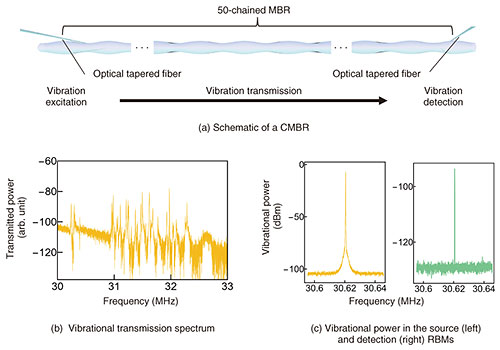
3. Mechanically coupled optomechanical array using microbottle resonatorsCavity optomechanics involving multiple mechanical modes has attracted great interest as a platform to explore nonlinear and nonequilibrium dynamics, synchronization phenomena, and topological physics. However, it has remained highly challenging to scale the number of mechanical modes because few device architectures enable many mechanical modes to couple to an optical cavity while preserving strong optomechanical coupling. We demonstrated a scalable optomechanical array that hosts multiple mechanical modes, fabricated by cascading the 50 microbottle resonators on a single optical fiber using a repeated heat-and-pull technique (see Fig. 2(a)) [2]. This optomechanical system, referred to as a chained microbottle resonator, has the following basic properties: (1) optomechanical coupling is obtained in each microbottle resonator; (2) optical WGMs are locally confined in each microbottle resonator; and (3) mechanical RBMs, especially higher-order axial modes, are coupled between two adjacent microbottle resonators via geometric mechanical coupling because the mechanical mode profiles overlap at the neck region connecting them. The third property is particularly unique to the resonator geometry on a silica glass fiber and enables direct mechanical interconnection with good scalability in the number of mechanical modes. This third property was demonstrated by optically exciting mechanical vibration at the left end of the chained microbottle resonator and optically measuring it at the right end using tapered optical fibers coupled to both ends (see Fig. 2(a)). By scanning the excitation frequency—more precisely, the intensity-modulation frequency of the laser on the left side—we obtained vibration transmission spectra (see Fig. 2(b)). Multiple mechanical modes are present that mediate mechanical coupling between adjacent nodes in the chain of the 50 microbottle resonators. The observation of finite vibration transmission over a broad frequency range further confirms strong mechanical coupling throughout the entire array. Optomechanical coupling can also induce self-sustained oscillation of mechanical vibration, which exhibits an extremely narrow linewidth in the mechanical spectrum, analogous to laser operation for light. By inducing self-sustained oscillation in the microbottle resonator at the left end of the array with an appropriate laser detuning, we succeeded in observing the propagation of such a “lasing” vibration through the 50 microbottle resonators (see Fig. 2(c)). In this sense, the chained microbottle resonator can be regarded as a vibrational counterpart of a laser, waveguide, and detector, all controlled optically. This fiber-based optomechanical array thus paves the way toward vibration-based metrology, signal processing, and programmable oscillator networks.
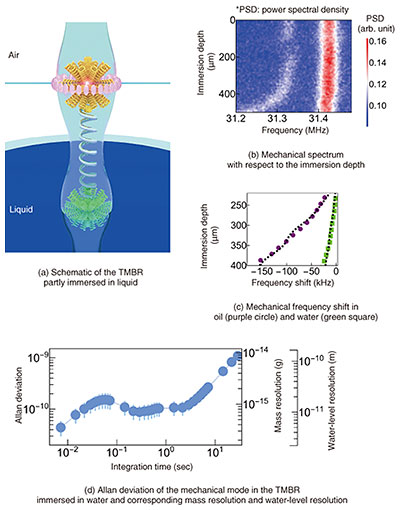
4. Liquid optomechanics using twin-microbottle resonatorsIn many applications of cavity optomechanics, such as label-free detection and identification of viruses, biomolecules, and nanoparticles in liquids using micro- and nanomechanical mass sensors, it is highly desirable to perform precise sensing directly in liquid environments. Although cavity optomechanical devices are attractive for such purposes because they combine high mechanical sensitivity with optical readout, directly immersing an optomechanical resonator in a liquid is often challenging: the optical Q factor is severely degraded by scattering and absorption in liquids. Fiber-type microbottle resonators provide a distinct route to liquid optomechanics that mitigates these issues. A particularly powerful configuration is the twin-microbottle resonator, in which two bottle-shaped cavities are formed in series on a single fiber. One microbottle resonator is kept in air to preserve an ultrahigh-Q optical WGM, while the other microbottle resonator is immersed in a liquid to provide strong fluid–structure interaction between the mechanical RBM and the surrounding fluid (see Fig. 3(a)). The two microbottle resonators are mechanically coupled through their shared neck region, so that the mechanical vibration in the liquid-exposed microbottle resonator can be read out optically via the high-Q WGM in the air-exposed microbottle resonator. Because the twin-microbottle resonator has a hair-thin radius, this “free-access” configuration enables local probing of liquids without sacrificing optical quality [3]. The basic operation of the microbottle-resonator-based liquid probe is demonstrated by monitoring the thermally driven RBM, without any external drive, while gradually immersing the lower microbottle resonator into a liquid. As the immersion depth increases, we can precisely track the changes in the resonance frequency and linewidth of the RBM owing to its ultrahigh displacement sensitivity via the high-Q optical resonance (see Fig. 3(b)). Because the frequency shift and linewidth broadening reflect changes in the density and viscosity of the surrounding fluid, we clearly observe different responses when immersing the twin-microbottle resonator in water and in oil (see Fig. 3(c)). From the measured frequency shifts, we can estimate the density–viscosity product of the oil by using the known density and viscosity of water as references. Beyond such basic liquid probing, the same platform can be tailored for specific sensing tasks. For sensing based on monitoring the mechanical resonance frequency, the minimum detectable signal is determined from both the responsivity of the resonance to the target quantity and its frequency stability. To improve the latter, we enhance the displacement sensitivity by introducing an optical interferometer and implementing a phase-locked loop, a standard technique for tracking a resonance frequency in real time. As a concrete example in liquid, we evaluate the mass resolution in water. From the Allan deviation, which quantifies the frequency stability, we obtain a mass resolution in the sub-femtogram range (see Fig. 3(d)) [4]. This demonstrates the potential of microbottle-resonator-based devices for label-free detection of nanoscale objects in liquids. The twin-microbottle resonator allows for gradual immersion into a liquid with a well-defined and finite immersion depth, and its mechanical response is sensitive to the liquid level. This capability is highly unique among optomechanical devices, as it enables direct interaction with the air–liquid interface. By exploiting this property, we estimate the water-level resolution to be on the picometer scale (see Fig. 3(d)) [5]. This constitutes the first demonstration of cavity optomechanics operating at an air–liquid interface, paving the way for future studies of interfacial dynamics, capillary phenomena, and surface-sensitive biochemical sensing.
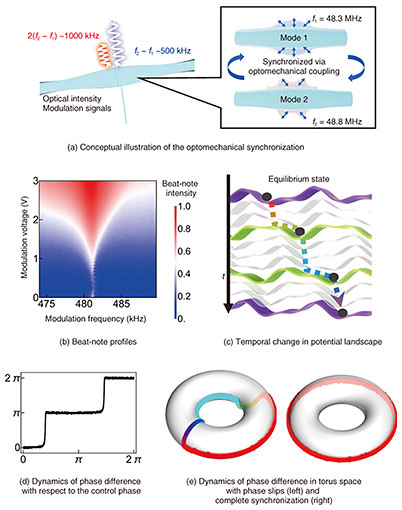
5. Synthesized mechanical synchronization via optomechanical couplingSynchronization is a ubiquitous phenomenon observed in systems ranging from biological rhythms and chemical oscillations to lasers and mechanical resonators and is often well described by a first-order differential equation for oscillator phases, the Kuramoto model. In most artificial devices, however, synchronization is induced by linear and static coupling between oscillators; therefore, the coupling function is essentially fixed by the underlying physical interaction and cannot be reconfigured. Synchronization-based nonlinear dynamics have thus remained largely unexplored. Fiber-type microbottle resonators offer a way around this limitation: by using light to mediate and temporally modulate the interaction between mechanical modes inside a microbottle resonator—an approach often referred to as Floquet engineering—one can engineer nonlinear coupling in phase space and uncover qualitatively new dynamical behaviors of synchronized oscillators, with a natural pathway to extend the scheme to networks of multiple mechanical modes within a single microbottle resonator or in a chained microbottle resonator. In our implementation, two distinct RBMs in a single microbottle resonator are driven into self-sustained oscillation via optomechanical coupling [6]. An external intensity modulation is applied to the pump laser such that the modulation frequency matches the difference frequency between the two mechanical modes (see Fig. 4(a)). This periodic modulation acts as a parametric drive that nonlinearly couples the phases of the two self-oscillating modes. Under appropriate conditions, the phase difference obeys an effective equation of motion analogous to the Kuramoto model, with a coupling term that can be interpreted as the gradient of a “Kuramoto potential” for the phase difference between the two mechanical modes. By tuning the modulation frequency and modulation depth, the shape and depth of this potential are controlled, leading to conventional phase locking. Figure 4(b) shows the beat-note intensity as a function of modulation frequency and modulation voltage: it becomes larger (smaller) when the phases are locked (unlocked). The red area reflects the synchronous state and forms a triangular region—called an “Arnold tongue,” a fingerprint of synchronization—in this parameter space. The microbottle-resonator platform enables richer control of synchronization-based dynamics through optomechanical Floquet engineering. By introducing higher-harmonic components into the intensity modulation and adjusting their relative phase (the control phase), the effective Kuramoto potential can be shaped into multiwell and asymmetric landscapes. By periodically modulating the relative phase between the first-order component and the higher-harmonic component, these multiwell landscapes can also be temporally modulated (see Fig. 4(c)). The phase difference between the two oscillators thus shows non-trivial phase “slips” within one period of the control phase (see Fig. 4(d)). Since both the control phase and observed phase difference are defined as modulo 2π, the dynamics of the observed phase difference can be mapped onto a torus surface. The non-trivial phase slips generate a finite winding around the torus, whereas a completely synchronized static state corresponds to zero winding (see Fig. 4(e)). These behaviors represent a new class of synchronization-based dynamics in which the topology of phase-space trajectories and the direction-dependent response are designed through optomechanical control of the coupling. These experiments demonstrate that microbottle resonators constitute a compact and versatile platform for exploring synchronization and engineered dynamics in cavity optomechanics. The ability to synthesize and dynamically tune nonlinear coupling between mechanical modes using optical means suggests promising applications in information processing based on the phase degree of freedom, neuromorphic computing, and programmable nonlinear oscillator networks.
6. SummaryWe have reviewed cavity optomechanics based on fiber-type microbottle resonators. After introducing the basic principles of microbottle resonators and their optomechanical coupling, we described a chained microbottle resonator that achieves mechanically coupled arrays and vibration transport on a single optical fiber. We then discussed liquid optomechanics using twin-microbottle resonators, which enable free-access probing of liquids with ultrahigh optical Q factors and strong fluid–structure interaction, leading to highly sensitive mass and liquid-level sensing. Finally, we presented optomechanical synchronization in a microbottle resonator, where optomechanically engineered Kuramoto potential and their dynamical control give rise to unconventional synchronization-based dynamics. These results establish fiber-type microbottle resonators as a powerful platform for extreme optomechanical sensing in complex environments. The combination of ultrahigh optical displacement sensitivity, low-loss mechanical modes, and direct mechanical access to liquids and interfaces enables the detection of minute changes in mass, density, viscosity, and liquid level without compromising optical performance. Further optimization of microbottle-resonator design and fabrication—together with integration of microfluidic structures, functional surface coatings, and biocompatible materials—is expected to push sensing performance toward ultimate limits and broaden applicability to advanced chemical, biological, and interfacial measurements under realistic conditions. The same platform naturally serves as a versatile testbed for nonlinear dynamics in optomechanical systems. The ability to host multiple mechanical modes within a single resonator, couple them in a controlled manner, and dynamically engineer their interactions using light enables systematic exploration of synchronization, multistability, and topological structures in phase space. Scaling from few-mode systems to extended networks of coupled microbottle resonators, combined with optomechanical Floquet engineering, enables programmable oscillator networks and phase-based information processing, providing a physical foundation for neuromorphic and reconfigurable optomechanical architectures. In this sense, microbottle resonators represent not only a device platform but also a unifying framework for scalable optomechanics across sensing and nonlinear dynamics. References
|
||||||||||||||