|
|||||||||||||||
|
|
|||||||||||||||
        |
Feature Articles: Technology Development Trends of the IOWN 2.0 Era—From Communications to Computing Vol. 24, No. 4, pp. 46–52, Apr. 2026. https://doi.org/10.53829/ntr202604fa5 Trends in Research and Development of the Latest Controller Technology Supporting Operation of the Evolving APNAbstractThe Innovative Optical and Wireless Network (IOWN) and All-Photonics Network (APN) are evolving rapidly in a manner that achieves even greater capacity, lower latency, and on-demand use, and the role of the APN controller in operating the APN is becoming increasingly important. Five technologies that support the evolving APN, as well as the latest trends in research and development of the APN controller, are introduced in this article. Keywords: IOWN, APN controller, advanced operations
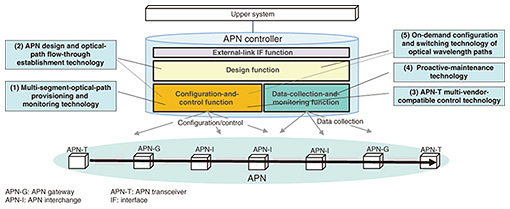
1. IntroductionThe Innovative Optical and Wireless Network (IOWN) and All-Photonics Network (APN) [1] have entered the “APN step2” phase, in which NTT Group companies are successively launching APN services while further evolving IOWN and the APN toward achieving higher capacity, lower latency, and on-demand use. In the January 2024 issue of this journal, we introduced the basic functions of the APN controller, which plays a key role in APN operations [2]. This article delves further into this controller technology by introducing five technologies that support the operation of the evolving APN: (i) multi-segment-optical-path provisioning and monitoring technology, (ii) APN design and optical-path flow-through establishment technology, (iii) APN-T*1 multi-vendor-compatible control technology, (iv) proactive-maintenance technology, and (v) On-demand configuration and switching technology of optical wavelength paths (Fig. 1).
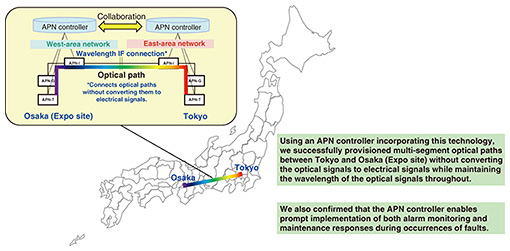
2. Multi-segment-optical-path provisioning and monitoring technologyThe IOWN APN aims to provide high-speed, highly reliable, and low-latency optical paths that span multiple segments. To achieve this, we are advancing research and development of the APN controller function that will enable the provisioning and monitoring of optical paths while coordinating between segments. Commercially available element management system products have functions for provisioning and monitoring optical paths within a single segment; however, they do not have functions for provisioning and monitoring optical paths spanning multiple segments. Focusing on this issue, we are currently studying methods and implementing prototypes for providing three functions: (i) managing network resource information for optical paths spanning multiple segments, (ii) provisioning optical paths in each segment according to network resource information, and (iii) sharing alarms and performance information within each segment. Using an APN controller implementing the above-mentioned technologies, we conducted a field trial in a commercial environment connecting the Expo 2025 Osaka, Kansai, Japan site and Tokyo. This trial demonstrated that it was possible to provide optical paths spanning multiple segments through cooperation between segments and to isolate problems through cooperation between segments. It thus confirmed the feasibility of provisioning and monitoring optical paths spanning segments even in a commercial environment (Fig. 2). We are currently organizing new requirements on the basis of feedback obtained during the trial operation and plan to further improve functionality.
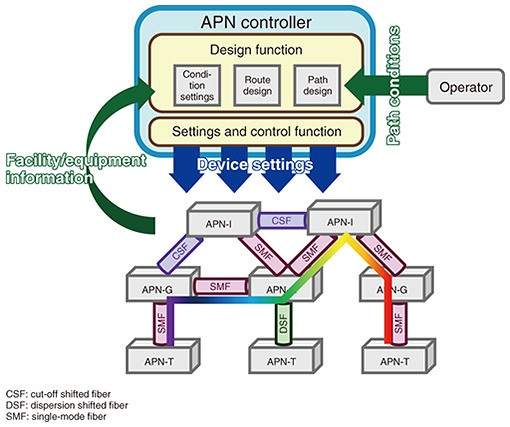
3. APN design and optical-path flow-through establishment technologySince the APN is made up of many interconnected devices, as the APN expands, the options for routes connecting end-user locations increase. The bandwidth and wavelength bands available for communications depend on, first, the type and installation status of the optical fiber connecting the relay locations at which the APN devices are installed and, second, the types of installed equipment. Since many end users share the same optical fiber and equipment, resources between some relay locations may be insufficient, so it might become impossible to provide new communications over those routes. Providing communication services to end users thus requires finding the optimal path-routing solution each time while taking into account the vast number of combinations and constraints, which is time-consuming and complicated. To address the above issues, we have developed APN design technology that automates the above process (Fig. 3). With this technology, by simply inputting necessary information such as end-user usage-location information, bandwidth-usage conditions, and conditions for distributing geographical routes to improve fault tolerance, multiple optimal-route candidates can be calculated automatically while taking into account a huge number of route combinations and constraints. For each of these optimal-route candidates, the expected communication quality can be automatically calculated on the basis of information such as the optical fiber and equipment composing the route.
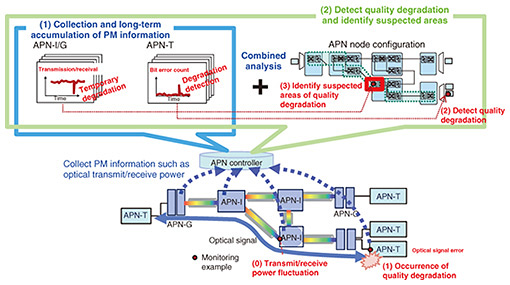
We have also developed optical-path flow-through establishment technology that automatically inputs the settings necessary to establish communication routes to the numerous devices that make up the APN (Fig. 3). By combining APN design technology and optical-path flow-through establishment technology, simply inputting the necessary information into the APN controller by an operator makes it possible to automatically calculate the optimal communication route and its communication quality from a huge number of combinations and constraints then input the settings into the devices that make up the APN to establish communication routes and provide communication services to end users. 4. APN-T multi-vendor-compatible control technologyThe APN uses a variety of equipment to provide users with overwhelmingly high-capacity and low-latency communications at low cost and to enable the flexible provision of a variety of services tailored to each user. In particular, an APN-T, which provides users with various interfaces (IFs) for APN services, makes it possible to use application-tailored models from a variety of equipment vendors, so that a variety of IFs can be provided to flexibly meet user needs. When these APN devices are operated, however, different models necessitate different configuration methods for opening optical paths and different methods for operating maintenance and operation functions; therefore, network operators must learn the methods for configuration and maintenance operation suited to each device model and use them in a way that suits each device. As the APN-device models that must be handled increase in number, the burden on network operators thus becomes greater. To solve the above issues, we have developed APN-T multi-vendor-compatible control technology that enables common control of various models of APN-Ts by using an open control interface. Specifically, by using Open Config, which is being developed as a common data model and application programming interface (API) specification for centrally managing network devices independent of vendors or protocols, we can provide common operations (e.g., opening optical paths and monitoring alarms) for different APN-T models. Many APN-T models use Open Config as the control interface, and using it enables them to be operated centrally in a way that significantly reduces the burden on network operators. By enabling the efficient operation of various APN-T models, we are able to provide flexible IFs tailored to each user of a particular APN service. 5. Proactive-maintenance technologyWhile the deployment of the APN is expected to reduce equipment costs by reducing the number of relay routers and transponders, the longer optical sections will make it more difficult to isolate and respond to service interruptions caused by degradation of optical-signal quality, and that difficulty could result in prolonged restoration work. To address this issue, we have developed proactive-maintenance technology as an advanced maintenance function for the APN controller. This technology uses information about the physical characteristics of optical signals, links that information to configuration information for analysis, and enables early detection of suspect areas of the APN (Fig. 4). Specifically, we are developing two major functions.
The first function is collection of performance monitoring (PM) information. It collects various statistical information from APN nodes, such as the transmit and receive power for optical signals managed by the APN nodes. It constantly collects PM information from all APN nodes at 15-minute intervals and stores PM information for up to 30 days so that past PM information can be analyzed. The collected PM information can be linked to configuration information and displayed on the graphical user interface (GUI) screen of the APN controller. The second function is fault determination. Triggered by bit error counts contained in the PM information collected from APN-Ts, this function (using the PM information) checks the transmit and receive power of all APN-I/G*2, *3 IFs through which the target optical signal passes and determines from the fluctuation range whether the power is normal or abnormal. It then determines the upstream IF from the IF judged to be abnormal as being in the suspect area. All optical signals passing through the IF judged to be suspect are also displayed on the GUI screen as affected signals. We are also developing a function that, even if fluctuation in transmit and receive power is not significant, can group optical signals that had similar bit error counts during the same time period and determine the common section (between IFs) through which the group of optical signals passes as the suspect section. These two functions make it possible to identify suspected areas quickly and dynamically when optical-signal quality degrades due to fluctuations in transmit and receive power at APN-Is/Gs. They can also respond to events in which transmit and receive power do not fluctuate across a nationwide network.
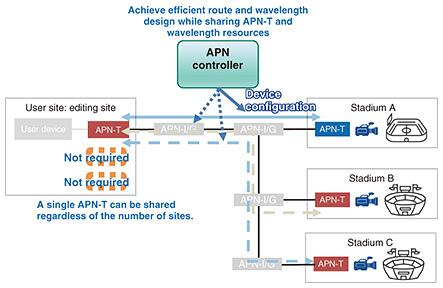
6. On-demand configuration and switching technology of optical wavelength pathsIn addition to supporting the conventional service format in which optical paths are used for long periods under control of an APN controller, we are researching and developing on-demand configuration technology of optical wavelength paths, which enables flexible opening and closing of optical paths in a short period, and on-demand switching technology of optical wavelength paths, which uses common resources to switch the connection destination to the required location flexibly. These combined technologies, called “on-demand configuration and switching technology of optical wavelength paths,” enable economical use of optical wavelength paths on demand according to user needs (including short-term use). The highly reliable, low-latency optical paths of the APN can also be used in use cases in which the connection destination needs to be switched according to the period, such as connections between stadiums and an editing center used for remote production (Fig. 5). Using on-demand configuration and switching technology of optical wavelength paths, the design function unit of an APN controller can automatically calculate routes, wavelengths, transmission quality, etc., which were previously calculated manually. By linking this with optical-path flow-through establishment technology on the basis of design data, it is now possible to automatically carry out the entire flow from design to provisioning on the basis of user requests. In addition to enabling the rapid provision of optical paths on the basis of user requests, it also enables setting up of rapid detours in the event of a major disaster by automatically designing the optimal detour route as the route to which the optical path will be switched.
We conducted a joint field trial [3] using an APN controller implementing the above on-demand configuration and switching technology of optical wavelength paths. In the trial, optical paths were opened on request from the user-controlled IP controller via an API, and it was demonstrated that on-demand configuration of paths, including L2/L3 configuration on the user side and traffic communication between application servers, was possible. By by-passing faults in optical paths, including wavelength converters, in a scenario simulating a failure during a major disaster, we also demonstrated that optical-wavelength-path switching can be completed within 10 minutes. 7. Future developmentsFive of the latest APN-controller technologies that we have developed, which we are researching and developing on a daily basis, were introduced in this article. We plan to continue developing the APN. In particular, we aim to create (i) control technologies for more efficiently accommodating and managing various devices configuring the APN, which will continue to expand to become a larger-scale network, (ii) more-advanced technologies for optical-path design and provisioning when operating many devices on the APN, and (iii) operation and control technologies applicable to communications between datacenters, which is the main use case for high-capacity, low-latency communications via the APN. References
|
||||||||||||||