|
|||||||
|
|
|||||||
        |
Front-line Researchers Vol. 24, No. 4, pp. 1–7, Apr. 2026. https://doi.org/10.53829/ntr202604fr1  Well-being Competency in Learning, Work, and Research SettingsAbstractThe importance of well-being, which places value on people’s existence and state of mind and cannot be measured solely by economic value, has been increasing. In an unpredictable era, characterized by rapid technological development and dramatic changes in social conditions, it is necessary for people to have the flexibility to think and act to adapt to diverse values and rapidly changing circumstances while working together to create and adjust paths as we move toward our goals. Junji Watanabe, a senior distinguished researcher at NTT Communication Science Laboratories is proposing and developing specific methods for acquiring and using well-being competencies in practical settings such as school education and corporate activities. We spoke with him about his recent areas of focus and his own research style. Keywords: well-being competency, education, employee engagement
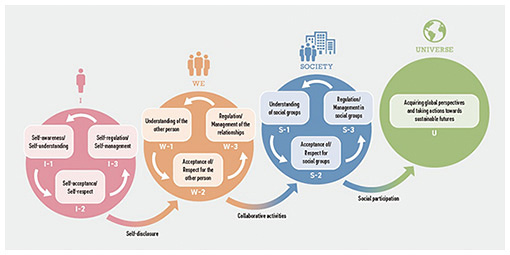
Developing competencies for living a life of well-being—Would you tell us about your recent activities related to research on well-being? In September 2025, we published a book titled “Well-being Competency—Ways of Thinking and Practical Methods for Incorporating Well-being into the Learning Environment” (by M. Taira, J. Watanabe, and M. Yokoyama; Toyokan Publishing). This book summarizes the content of our research to date, including specific practical methods, on how to foster “well-being competency” in school education, primarily for students in elementary and junior high schools, so that our research accomplishments can be directly useful to teachers in the field. One of the reasons for publication of this book is the explicit statement of “improving well-being rooted in Japanese society” in the Fourth Basic Plan for the Promotion of Education, approved by the Japanese Government Cabinet in June 2023. When well-being is authorized as part of education and positioned as a concept that everyone should understand as a common language for creating a future society, it’s easy to imagine that teachers might feel a certain amount of anxiety. Teachers are likely to be troubled by the prospect of updates to curriculum guidelines and other documents while they wonder how to teach well-being to students. We hope that our book will serve as a bridge between the concept of well-being and the practices of teachers. Teachers are busy, so if they think, “Here’s another unnecessary task...”, it would be counterproductive. First, we tell teachers that learning about well-being does not replace the learning they are currently supporting; rather, it adds new value. Let us take a brief look at well-being competency. “Competency” refers to practical qualities and abilities that are not limited to specific fields. It includes not only knowledge but also attitude toward society and problems as well as the ability to make decisions and act appropriately in specific situations. Well-being competency means “practical qualities and abilities needed for living a life of well-being” and requires each person to be able to find their own way of being in the various environments and situations of their daily lives. To develop well-being competency in the educational field, we proposed the Well-being Competency Model (Fig. 1). The model divides the scope of relationships that achieve well-being into four categories: “I”: myself, “We”: people close to me, “Society”: society including the public, and “Universe”: a larger entity. We have established a total of nine competencies—based on the three perspectives of cognition, emotion, and action—for the “I,” “We,” and “Society” categories and one competency for the “Universe” category, making a total of ten competencies that should be acquired as well-being competencies.
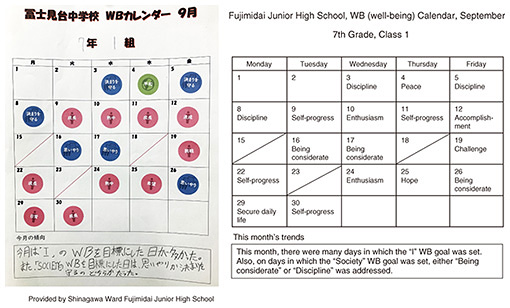
Acquiring “I” competencies related to self-understanding, self-acceptance, and self-regulation will enable self-disclosure with those close to you; acquiring “We” competencies will enable collaboration with those close to you; and acquiring “Society” competencies is expected to enable active participation in society. It is thus necessary to acquire competencies from the four categories; however, naturally, they don’t have to be acquired in a particular order, and the competencies in each category influence each other. The Well-being Competency Model is used in schools to put well-being competencies into practice, and our book broadly categorizes these practices into “targeted” and “arranged” types. The targeted type refers to educational activities with the primary purpose of acquiring and improving well-being competencies and are likely to be highly compatible with subjects such as “The period for integrated studies (inquiry-based learning),” “special subject on moral education,” and “classroom activities.” In contrast, the arranged type refers to educational activities with the primary goal of learning existing subject content (such as Japanese language or social studies) in which well-being concept is incorporated as a secondary component. In education, the annual class hours for each subject are set by curriculum guidelines, so it is difficult to incorporate well-being lessons into those hours. However, arranged practices based on existing educational activities are a means of effortlessly incorporating well-being into everyday lessons and activities. For example, in Japanese-language classes, simply changing the statement “Put yourself in the protagonist’s shoes” to “Consider what well-being the protagonist valued and acted on accordingly” can set tasks related to the “I” competency. In home-economics classes, a task such as “Let’s cook a meal while considering the well-being of our family” could be linked to learning related to the “We” competency. In social-studies classes, asking “What can I do to help people in depopulated areas live to achieve well-being?” could be expanded to address the “Society” competency. Another example of an arranged practice can be seen in classroom activities. During morning assembly, students introduce the “well-being that the class wants to prioritize today.” This well-being priority is then recorded daily and color-coded into the aforementioned four categories. This process creates a monthly calendar that makes it possible to visualize the things the class wants to prioritize and understand daily changes due to events (Fig. 2). This practice has enabled students to develop the habit of thinking about not only themselves but also the whole class by applying the reflections from the previous day’s class to their own actions on the present day.
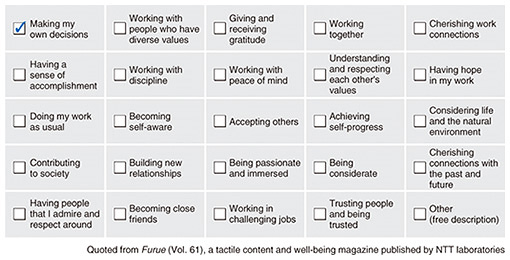
In some cases, students write down what they want to emphasize in events, such as choir competitions, sports days, and school trips, and use this information to foster mutual understanding. It is thought that the process of realizing that different people have different opinions about the same event, understanding differences in values, and acquiring well-being competencies is meaningful for students. This kind of arranged practice also has the effect of deepening connections between teachers across subject boundaries. For example, playing in a musical ensemble and playing in a sports team both lead to acquisition of well-being competencies in the “We” category; as a result, conversations about well-being are progressing even between teachers of different subjects. —You are also applying the concept of well-being to employee engagement in corporations, right? We want to expand the knowledge that we have gained from incorporating well-being in education into various practical areas within a company. A recent topic is our project related to employee engagement in collaboration with NTT’s General Affairs Department. For the annual survey of all NTT Group employees, the Group has adopted questions we developed from a “well-being values” perspective, starting in fiscal 2023 (Fig. 3).
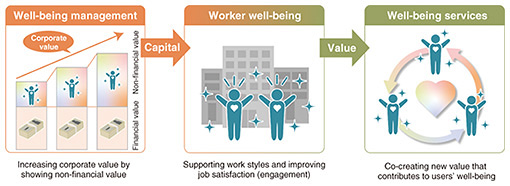
The details of the employee-engagement project are available in Furue online [1], but I’ll present some of the analysis of the survey results. Regarding the NTT Group as a whole, values such as “trusting people and being trusted,” “Giving and receiving gratitude,” and “contributing to society” were ranked highly, and that finding is considered unique to an infrastructure company with a mission to connect the entire country. Within these results, it is clear that not only “I” values related to peace of mind, self-progress, and accomplishment but also “We” values (such as trust and gratitude) and “Society” values (which emphasize contributing to society) tend to increase as the employee’s position rises. It is also clear that when differences by age are focused on, younger employees tend to choose “I” values, while employees in their 50s increasingly choose “We” and “Society” values. These results suggest that it is important to provide younger employees with a place where they can work with peace of mind and opportunities to take on new challenges; in contrast, for older employees and those in higher positions, it is necessary to implement measures that emphasize interpersonal connections and contributing to society. Setting goals, allocating tasks, and engaging in daily communication on the basis of an understanding of each employee’s values is likely to improve employee engagement. We hope to verify these results through tests both within and outside the NTT Group by combining analytical methods with training and other measures to determine how we can increase employee engagement as a company and systematize a methodology for measuring, analyzing, and improving employee engagement on the basis of the well-being of each employee. Expanding our scope to develop services that bring about well-being—Tell us about your future developments. I hope to apply the concept of well-being to not only school education but also corporate management, work styles, and even service development (Fig. 4). In education, NTT Group companies are providing services in line with the Ministry of Education, Culture, Sports, Science and Technology’s GIGA (Global and Innovation Gateway for All) School Initiative. It may be possible to incorporate well-being educational content as added value in communication services. Services are not just about improving the well-being of users; they are also about users and providers creating well-being together. With that point in mind, I believe that applying the well-being concept to service development will be an especially important area from now onwards.
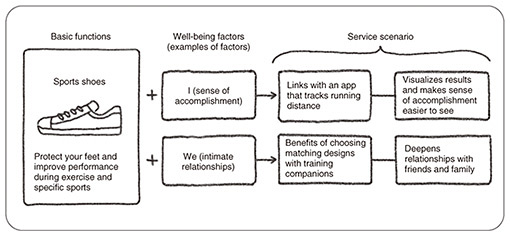
The concept of developing services that contribute to well-being is also compatible with the concept of well-being education. Regarding learning well-being competencies in school education, I touched on “targeted” and “arranged” practices, and that classification can also be applied to service development. Service development sometimes focuses on certain well-being factors, while at other times, well-being experiences can be added on the basic function of improving functionality and productivity. These two types of service development are likely to cover a wide range of service areas. For example, “targeted” service development tends to be suited to services related to mental healthcare, beauty and health, and work styles, while “arranged” service development is thought to be more applicable to materials development and business-to-business businesses. Let us look at some specific examples of the “arranged” service development. For example, the basic function of a product, such as sports shoes, is to “protect the feet and improve performance when playing sports.” If, as an “arranged” service, the product is linked to an app that records the running distance, users will be more likely to feel a sense of accomplishment. Another “arranged” service would be to offer the bonus of being able to choose matching designs with friends who train together, thereby deepen relationships with them (Fig. 5). Even with the same basic functions, the value of the service depends on the well-being that is focused on when the arrangement is made.
—Would you tell us about your research style and approach as well as any messages you might have for junior researchers? When it comes to researchers, most have a clear subject they want to research, a specialty in which they excel, and the goal of becoming a leading expert in their field. Perhaps I’m different from this type of researcher in that I value sensing the trends in society and getting involved in them. By letting myself go with the societal trends, and sometimes making various arrangements, I hope to be able to reach a place that is good for myself, the people around me, and society. I think of myself as a “material” and consider how I can be used best. If someone is more capable than me, I think it is important to leave it to them. The world is full of experts and stakeholders in various fields. Personally, I don’t have the mindset to be too concerned with specialization, so perhaps I’m suited to combining various things to create value. When I say things above, I’ve been asked, “Is that something a researcher should do?” To be honest, if you stick to your own specialty, you can only do what you think is right, and what you can do on your own becomes limited. With a few exceptions, the time that a single person has influence within the framework of research is not that long. In the time I have left, I intend to do as much as I can, even if it’s not my specialty, if my involvement can be of value to someone. In that sense, I value “involvement.” After completing graduate school, I worked as a PRESTO researcher at the Japan Science and Technology Agency. After that, I joined NTT, a company that I had a connection with since my student days, where I have been working for over a decade now. During that time, as I gained a variety of experiences, there were times when someone was looking out for me without me knowing, and I might unintentionally cause trouble for someone. I have been involved with people more than I realize; therefore, I want to fulfill my role by using my imagination to consider the distance and balance not only with the people in front of me but also with those beyond them. Incidentally, I sometimes use the term “research editing” to describe the act of finding value in the intersections of various activities and making them visible and perceptible. I also value being able to use myself in a convenient way for others. If I come to someone’s mind when something happens, that time is sure to be an opportunity to start a new activity with them. I have communicated with people, including researchers, managers, educators, and politicians. I believe these encounters have been an asset and have broadened my perspective on value. As a research editing activity, I’m currently working on the Social Collaboration Initiative on Sustainable Well-being [2], a collaborative program between NTT and the University of Tokyo, as the NTT representative. To those who follow me, instead of simply focusing on what you want to do, I want to encourage you to approach research with a broad perspective. First, produce output while being “swept away by the larger current” then use that output as material to “edit” your own value. After that, have someone else use the output to create a different output. Then “re-edit” your own value and repeat this process. This process will create both heteronomous and autonomous value. It might take a certain amount of training to gain the skills to achieve this self-editing and re-editing; specifically, you need the ability to get things done, adapt to change, and edit yourself to find value in different things. However, at least for me, these skills are essential well-being competencies for maintaining well-being in a research setting. References
|
||||||