|
|||||||||||
|
|
|||||||||||
        |
Feature Articles: Research and Development toward Sustainable Infrastructure Vol. 24, No. 5, pp. 14–19, May 2026. https://doi.org/10.53829/ntr202605fa1 Technologies for Infrastructure SustainabilityAbstractAt the Sustainable Device Technology Laboratory in NTT Device Technology Laboratories, researchers in a wide variety of technical fields with basic knowledge in chemistry and physics seamlessly combine their skills in engineering and programming to conduct research and development that contributes to a sustainable society. One of our research and development themes is sustainable-infrastructure technologies. We aim to implement infrastructure that is both safe and economical in maintenance and management, not only for the communication infrastructure within the NTT Group but also for the entire social infrastructure. Keywords: infrastructure, smart maintenance, materials
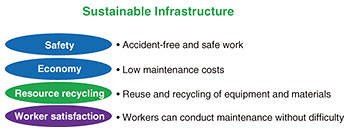
1. Sustainable-infrastructure technologiesIn 2025, there were major accidents due to deteriorating infrastructure. In Yashio City, Saitama Prefecture, collapsed sewer pipes (42 years after installation) caused road cave-ins, and in Okinawa Prefecture, ruptured sewer pipes (59-year-old water conduit transferring water from a dam to a water treatment plant) caused widespread water outages. These are examples of social infrastructure deteriorating at the same time while maintenance costs and personnel are decreasing, making it difficult to guarantee safety and security. We do not believe that these facilities were neglected regarding their maintenance and management. The NTT Group is also focusing on the maintenance and management of its communication infrastructure. However, the combination of aging and resource depletion can lead to such accidents. If we renew aging infrastructure, we should be fine for 40 more years. However, it will deteriorate after those 40 years. For infrastructure to continue to be used without incident, that is, to be sustainable, it is necessary not only to renew but also maintain and manage it properly to prevent deterioration and maintain it as soon as it starts to deteriorate. However, there is a limit to perfect maintenance with limited costs and personnel. The Sustainable Device Technology Laboratory in NTT Device Technology Laboratories is advancing the development of smart maintenance and sustainable materials. In response to business needs to reduce maintenance costs and improve safety, we are conducting research and development (R&D) on sustainable-infrastructure technologies to achieve a sustainable infrastructure that is both safe and economical. 2. Toward a sustainable infrastructureThe following is how we think about sustainable infrastructure. As mentioned above, it should be able to be used without any accidents, i.e., ensuring safety. This includes not only ensuring that infrastructure facilities are not damaged but also that maintenance workers can work safely. This includes, for example, preventing oxygen shortage in enclosed spaces, such as maintenance holes, and falls when working at heights. Next is the economics of maintenance and management. Of course, maintenance costs money. No matter how good the facility is, if the maintenance costs are too high, it will be difficult to keep using it. The concept of circular economy*1 is also important; it is also necessary to consider resource recycling such as reuse and recycling of infrastructure and the resources and materials used for infrastructure. The introduction of robots, artificial intelligence (AI), and other technologies is essential for infrastructure maintenance, but there are still many areas where human work is necessary. Therefore, we believe that it is also necessary to develop technologies that enable workers to maintain and manage infrastructure without difficulty. In other words, one of the requirements is to consider worker satisfaction. Our four requirements for sustainable infrastructure are shown in Fig. 1. We introduce the technologies we are investigating to implement this sustainable infrastructure.
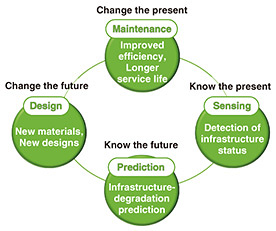
3. Four areas of R&DFigure 2 shows the four areas of R&D on sustainable-infrastructure technologies that we see as areas for technology creation. We consider two approaches to infrastructure maintenance. One is to know the state, such as whether it has deteriorated and when it is likely to reach the end of its life. The other approach is to change as a way of coping. The time axis is also divided into the present and future; what should we do now with our existing infrastructure; what should be done with the existing infrastructure in the future; and what should be the infrastructure to be introduced in the future? The following four areas combine the above two approaches and two time horizons.
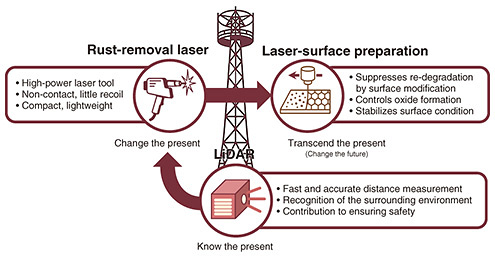
The first area is maintenance to change the present. To continue using existing infrastructure facilities for a long period, we aim to improve the efficiency of maintenance and management work and prolong the life of the facilities. To improve work efficiency, for example, the time and personnel required for maintenance and management can be reduced through automation. In extending the life of facilities, the maintenance cycle is extended or the frequency of renewal is reduced by introducing repair methods to make the facilities usable for a longer period, thus reducing the cost and time required for maintenance. The development of easy-to-use maintenance methods and tools also leads to worker satisfaction. The second area is sensing to know the present. Even if there is good maintenance technology, if maintenance is not carried out at the optimum time and the maintenance cycle is kept short, efficiency will be poor. If maintenance is not carried out for a long period even though it has deteriorated, it will lead to infrastructure failure, and the infrastructure will eventually need to be renewed within a short time. For example, if it is possible to know the status of the infrastructure remotely during regular inspections, it will be possible to reduce the cost and personnel required for inspections. If infrastructure degradation and abnormality can be detected in real time, infrastructure failures can be prevented in advance and efficiently. The third area is to know the future to predict how and for how long the deterioration of infrastructure will progress in each installed natural environment. If one can predict the deterioration of existing infrastructure, they can maintain rapidly deteriorating facilities for a long period without further deterioration (one needs to optimize the life-cycle cost considering maintenance and renewal costs). If one can identify the facility that deteriorates slowly, they can reduce the cost and time required for maintenance by extending the maintenance cycle to the limit. The fourth area is to change the future. Deterioration prediction to know the future is to clarify the environmental factors and materials that cause infrastructure degradation. By accumulating such knowledge, it will be possible to adopt materials that are resistant to degradation and design new infrastructures that are resistant to degradation. Ultimately, maintenance-free infrastructure is expected. The goal is to transform the infrastructure of the future into a long-lived infrastructure that is different from the existing infrastructure. Designing materials that are easy to recycle or that have low environmental impact can contribute to resource recycling. Even new infrastructures that are designed and deployed on the basis of degradation prediction will need to be maintained efficiently and degradation and anomalies detected unless they are completely maintenance-free. It is important to advance technological development in each of the four areas in line with the introduction of new infrastructure facilities. Continuously promoting development and introducing infrastructure that is easy to maintain and manage will lead to a sustainable infrastructure. 4. Smart Maintenance Technology Research GroupThe Smart Maintenance Technology Research Group, which is one of research groups of our laboratory, is mainly responsible for technology development to change the present and know the present. Our goal is to create next-generation maintenance technologies that enable labor-saving and safe and secure working environments. In addition to understanding phenomena based on physical properties and chemistry and knowledge of field applications based on laser engineering and electromagnetic wave engineering, we are working to integrate robotics and AI with this understanding and knowledge. Focusing on infrastructure-cleaning technology using high-power lasers that can remove deteriorated materials without contact, we are promoting R&D that contributes to understanding facilities conditions, detecting abnormalities, improving work efficiency, and prolonging the life of facilities. To prolong the service life of communication towers made of steel, it is important to suppress the generation of rust and remove it. Electric tools and metal brushes are used to remove rust, but manual work is essential, and it is difficult to remove rust in narrow spaces and around bolts. Sandblasting, in which sand is driven at high speed, is one technique for removing rust from narrow areas. However, it is difficult to use because it requires time and effort to recover the sand. To make such work more efficient, save labor, and improve safety, the rust-removal equipment must be small, light, have a little recoil, and be able to remove rust efficiently. Equipment with these features may be used for advanced work combined with robotics and AI in the future. From this point of view, we are focusing on a rust-removing tool (rust-removal laser) using a high-power laser that satisfies these conditions. As shown in Fig. 3, we are conducting R&D mainly on three technologies: rust-removal laser, laser-surface preparation, and light detection and ranging (LiDAR).*2
We have been developing small and light rust-removal lasers using a diffractive optical element (DOE). A DOE is a device applying hologram technology that modulates the phase of the incident light by the fine structure on the substrate and can convert the shape of the incident laser light into the desired shape though it is a light element of several grams [1]. Taking advantage of this feature, we have sped up rust-removal work by spreading the laser beam from point to line. We have thus accumulated a wide range of knowledge on the reaction between high-power lasers and steel products as a core technology that contributes to the efficiency and labor saving of rust-removal work, such as exploring the appropriate laser-irradiation conditions for efficient rust removal and finding laser treatment that makes the surface of steel products stable and resistant to deterioration. These findings also will lead to a new direction of not only removing rust but also controlling the chemical state of steel surfaces to prevent re-degradation. We are conducting research to achieve a steel surface that does not deteriorate over a long period by using the oxide formed by laser irradiation and that can be repainted after repair. We are also investigating a high-speed and high-precision ranging technology using LiDAR as one of the basic technologies for such labor-saving and advanced technologies. Interference signals obtained with a wavelength-swept light source and interferometer are sampled at regular intervals and processed using an original algorithm to achieve high-speed and high-precision distance measurement. If the distance to the object can be determined in real time (in milliseconds) and with high accuracy (within micrometers), the surrounding environment where the high-power laser is handled can be properly recognized, and the laser can be handled safely and accurately. Specifically, it can be used to determine the position and shape of the target structure and confirm the work area. It also contributes to ensuring safety during laser irradiation. These technological developments are examples of R&D on sensing technology that knows the present to implement technology that changes the present by making rust-removal work more efficient and advanced. We aim to develop such technologies that lead to economy, safety, and worker satisfaction.
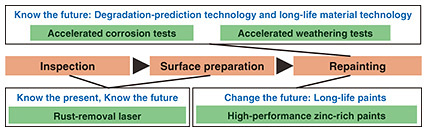
5. Sustainable Material Research GroupThe Sustainable Material Research Group within our laboratory is mainly responsible for developing technologies to know the future and change the future. On the basis of chemical-analysis technology, acceleration-test technology, degradation-prediction technology, and data-analysis technology for various infrastructure materials, we are promoting R&D that contributes to efficient facility maintenance on the basis of degradation prediction and environmental prediction, life extension by repair, and life extension by material change. A wide variety of materials are used for infrastructure facilities. Examples include metal materials such as steel used for steel towers; concrete used for utility poles and maintenance holes; and organic materials such as plastic used for closures and lower branch line covers. These materials are rarely used alone, e.g., concrete contains reinforcing bars, hardware and cables (the outer skin of which is made of organic materials) are installed inside maintenance holes, and organic paint is applied to steel facilities, such as steel towers, to prevent rust. Infrastructure facilities are exposed to varying environmental conditions because they are installed outdoors, e.g., weather conditions such as sunlight and rainfall and average temperature. There are also varying regions, such as snowy areas, those prone to typhoons, and coastal areas prone to salt damage. To enhance the safety and sustainability of infrastructure facilities, where various materials are exposed to various environments, it is thus important to evaluate and analyze infrastructure materials with appropriate methods as well as clarify the degradation mechanism, select excellent materials, and propose countermeasure technologies. To elucidate the mechanism of degradation, we are developing an accelerated test that reproduces phenomena similar to those occurring in actual environments in a shorter period, thus clarifying the progress of degradation that differs depending on the environment and parameters such as degradation factors (water, oxygen, ultraviolet rays, etc.). We are also analyzing and evaluating deteriorated facilities recovered from actual facilities and deteriorated conditions created by accelerated tests and evaluating the conditions during deterioration to clarify the deterioration mechanism. Figure 4 shows our investigation to date on degradation-prediction technology and long-life material technology, taking the example of a communication tower [2]. A steel tower is painted to protect the steel surface. The maintenance of a steel tower is carried out during inspection of whether the paint has deteriorated and whether the steel has rusted, then during surface preparation to remove old paint and rust, and finally during repainting. In the inspection and surface-preparation process, efficiency-improvement technology using rust-removal lasers (Section 4) can be applied. Our group is investigating applying degradation-prediction technology and long-life material technology to the repainting process. Accelerated testing methods, such as accelerated corrosion tests and accelerated weathering tests, are being developed as evaluation techniques for screening long-life coatings. We are also working to improve the performance of zinc-rich paints (paintings containing highly concentrated zinc powder) by using additives.
To know the future and change the future, we are conducting research at the material level not only on steel towers but also on various infrastructure facilities. Knowledge of materials research leads to appropriate material selection and design development of infrastructure facilities. It can also be used to estimate and predict the risks associated with facility deterioration and failure, enabling the creation of an efficient maintenance and management environment through prioritization. In addition to economic efficiency and safety, we aim to develop technologies that take resource recycling into account. References
|
||||||||||