|
|||||||||||||||||
|
|
|||||||||||||||||
        |
Feature Articles: Keynote Speeches and R&D on Access Networks Presented at Tsukuba Forum 2026 Optical Access Network Technologies for the AI EraAbstractArtificial intelligence (AI) has advanced dramatically. Its adoption across a wide range of industries is improving operational efficiency and accelerating business transformation. To prepare for its widespread adoption, NTT Access Network Service Systems Laboratories is conducting research and development of optical access network technologies. This article provides an overview of the impact AI will have on optical access networks and outlines NTT Access Network Service Systems Laboratories’ research directions and related technologies. Keywords: optical access network, physical AI, All-Photonics Network (APN)
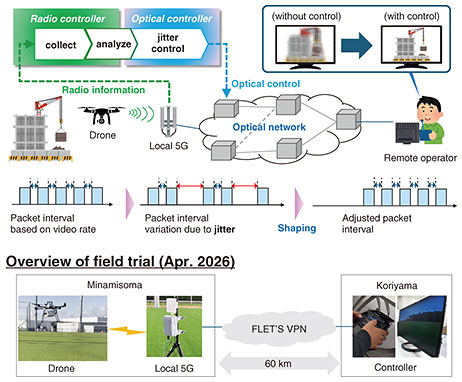
1. Changes in optical access servicesAs traffic volumes continue to increase, optical access networks are being upgraded to support higher transmission speeds. Commercial deployment of 10-Gbit/s-class services is expanding, while standardization of 50-Gbit/s-class systems is nearing completion, and discussions are beginning to focus on 100-Gbit/s-class systems. At the same time, rapid advances in artificial intelligence (AI) are improving operational efficiency and accelerating business transformation across a wide range of industries. These developments are beginning to change the requirements for optical access networks. According to one forecast [1], traffic volume is expected to increase to approximately 14 times its 2020 level by 2030 and approximately 348 times that level by 2040. The mix of applications generating this traffic is also expected to change. An increasing proportion of traffic will be generated by emerging applications such as autonomous driving, the metaverse, physical AI, and the remote operation of drones and other devices, rather than by conventional broadcasting, video, and web services. Traffic generated by applications such as autonomous driving is often processed and consumed close to where it originates. Considering that this type of communication takes place entirely within the local region, there are several implications for the design of future optical access networks. It can reduce the bandwidth required in a backbone network and the associated costs, while shorter communication distances can reduce latency and improve responsiveness. It may also drive the deployment of data-processing servers at the network edge. The placement of servers that execute AI processing will therefore be an important design consideration. As agentic AI becomes more widely used and AI systems increasingly exchange information to perform tasks autonomously, traffic volumes and traffic patterns may become more difficult to predict. Physical AI is also an important technology for considering the design of future optical access networks, because its applications often require low-latency, real-time communication. Accordingly, various physical-AI applications are being studied as potential use cases for the All-Photonics Network (APN). The design of future optical access networks must take into account not only these changes in services and applications but also the requirements of the sixth-generation mobile communication system (6G), which is expected to be commercialized in the 2030s. These requirements include extremely high data rates, extremely low latency, and massive connectivity [2]. To address these changes and demanding performance requirements, the Optical Access Systems Project at NTT Access Network Service Systems Laboratories is conducting research and development (R&D) in the following three directions. 2. Directions for optical access network technologies2.1 Direction 1: Greater flexibilityTo accommodate increasingly diverse services and changing traffic patterns, optical access networks must not only provide greater capacity but also support a wide range of bandwidth options cost-effectively. Greater flexibility will also be required when, where, for what purposes, and under what conditions networks are used. For example, as physical AI becomes more widely adopted, robots may operate at night as well as during daytime hours when people are at work, thus changing the temporal patterns of network usage. Networks will also need to adapt to changes in the operating environment so that AI-enabled systems can continuously learn from their surroundings and operate autonomously and reliably. 2.2 Direction 2: Lower latency and jitterTime-division-multiplexing passive optical networks, which are widely deployed in commercial services, enable multiple users to share upstream bandwidth and are commonly operated on a best-effort basis. As AI becomes more prevalent, demand is expected to increase for services that guarantee specified levels of low latency and low jitter. Another key challenge in supporting AI-enabled services is ensuring end-to-end performance across the entire communication path, including the optical access network, radio access network, and edge servers. 2.3 Direction 3: More efficient network operations“AI for network” will also play an increasingly important role in optical access systems. Using AI to automate network design, maintenance, and operations will improve operational efficiency. In optical access networks, maintenance and operational responsibilities extend to communications equipment installed on customer premises. Technologies for remotely configuring and controlling such equipment are therefore important for maintaining service availability and ensuring that services remain accessible whenever needed. The following sections describe our R&D activities to advance optical access networks for the AI era. 3. Optical-wireless cooperation technologyAs discussed under Direction 2, achieving low end-to-end latency and jitter for service delivery requires coordinated performance management across all relevant network and computing domains. This includes quality-of-service control across the optical access network, radio access network, and edge computing servers. As an example of optical-wireless cooperation, Fig. 1 shows an overview of the technology under study and its application to the remote inspection of infrastructure using a drone.
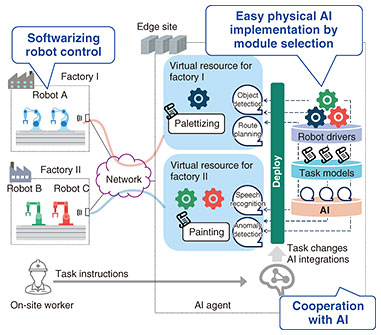
In this field trial, a local 5G was used for the wireless segment, while NTT’s FLET’S virtual private network (VPN) was used for the wired segment. An operator remotely controlled the drone while viewing video transmitted from the inspection drone. Local 5G uses time-division duplexing, in which the uplink and downlink share the same frequency band and transmit during separate time intervals. Uplink transmission is therefore permitted only during designated time slots. Congestion caused by traffic from other users can also lead to delays and retransmissions due to packet loss. These factors can cause variations in the arrival intervals of video packets, resulting in jitter in the local 5G segment. The resulting degradation in video quality can make the drone more difficult to operate remotely. To reduce jitter introduced in the wireless segment, the optical-wireless cooperation technology obtains control information on radio transmission timing from the radio base station via a radio controller. On the basis of this information, an optical controller then equalizes signal intervals in the optical (wired) segment to reduce variations in their arrival intervals. This coordination reduces end-to-end jitter, stabilizes the video received by the operator, and enables more reliable remote drone operation [3]. We conducted a field trial in which a drone located in Minamisoma City, Fukushima Prefecture, Japan was remotely operated from Koriyama City, approximately 60 km away. Local 5G was used for the wireless segment, and FLET’S VPN provided wired connectivity between the two locations. The field trial confirmed that an operator could remotely control the drone while viewing video transmitted from the drone. We are currently working toward the practical application of this technology to a broader range of remotely operated systems, including drones, other unmanned aerial vehicles, and robots. 4. Technology for applying software-defined networking (SDN)* to industrial equipmentIndustrial robots are representative examples of physical AI systems (Fig. 2). Their control functions are currently implemented primarily in dedicated hardware. Implementing these functions as software at the edge makes them easier to modify and enables more advanced robot control through integration with AI.
For example, a palletizing application can be constructed by combining three software components: a robot-specific control driver, palletizing task model, and widely used image-analysis AI. This modular approach eliminates the need to develop the entire control application from scratch and enables new tasks to be implemented more easily by reusing existing software components. Tasks can also be modified through natural-language instructions with speech-recognition technology based on a large language model, eliminating the need for complex manual reprogramming. We have implemented software-based protocol drivers for EtherCAT and PROFINET, both of which are widely used in industrial networks [4]. By separating robot-control applications from differences in manufacturers and communication protocols, these drivers make it easier to modify robot tasks and replace a robot with a model from another manufacturer. This approach is expected to facilitate the wider adoption of physical AI in industrial applications.
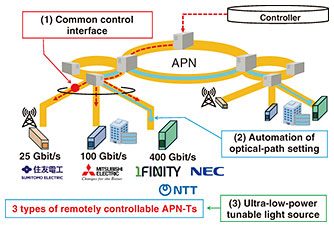
5. Technology for remotely controlling APN optical transceiversThis technology addresses Directions 1 and 3. It remotely configures and controls optical transceivers installed at user sites in the APN (Fig. 3), referred to as APN transceivers (APN-Ts) [5]. Through a common control interface, the controller communicates with various types of remotely deployed optical transceivers [6]. Control signals are multiplexed with the primary optical signal and transmitted over the same optical fiber. This mechanism enables the optical transmission parameters required to provision the APN, including the wavelength and transmit optical power of each APN-T, to be configured remotely and automatically. APN provisioning can thus be completed without dispatching workers to user sites, reducing the provisioning time to approximately one-hundredth that required by the conventional process.
In collaboration with other companies, we are currently conducting R&D on 25-, 100-, and 400-Gbit/s APN-Ts to support services with different application requirements. In parallel with technology demonstrations, we are contributing to standardization activities, including submitting technical proposals to the Open ROADM Multi-Source Agreement. Some of the research results were obtained from the grant program (No. JPJ012368G50201) by the National Institute of Information and Communications Technology (NICT), Japan. 6. Future outlookThis article has examined how the growing use of AI is expected to impact optical access networks and presented our R&D directions and related technologies. Optical access networks will play an important role in promoting a more prosperous society built on AI. As the APN expands geographically and its capabilities are extended to optical access networks, users will be able to access a wider range of services. We will continue to advance R&D on optical access network technologies to meet the evolving requirement of the AI era. References
|
||||||||||||||||