|
|||||||||||||||||||||||||
|
|
|||||||||||||||||||||||||
        |
Feature Articles: Pioneering Optical Quantum Computers through Optical Communication Technologies Software Technologies Supporting Optical Quantum ComputersAbstractTo use optical quantum computers as practical computing platforms, software technologies that connect applications with optical quantum hardware are essential. This article presents an overview of software for optical quantum computers and introduces research and development on a software development kit that enables users to describe problems and tune parameters without specialized knowledge of quantum computing, as well as system software that coordinates quantum and classical computing resources and supports efficient, highly reliable execution through quantum error mitigation. Keywords: optical quantum computer, optical quantum computing SDK, quantum error mitigation
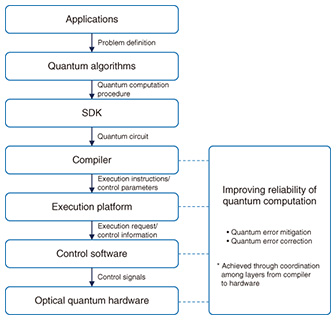
1. Overview of software for optical quantum computersTo use optical quantum computers for real-world problem solving, it is essential not only to improve the performance of optical quantum hardware but also develop software technologies that connect applications with that hardware. Software for optical quantum computers enables users to describe the problems they want to solve as quantum computations, converts those descriptions into forms that can be executed on the target optical quantum hardware, manages computing resources, and returns the obtained results to the users. Figure 1 shows a representative configuration of software for optical quantum computers. The boxes in the figure indicate the functions of each layer, while the labels on the arrows between boxes show the main data and representations passed between functions as interfaces.
At the top-level application layer, users define problems to be solved using an optical quantum computer, such as combinatorial optimization, machine learning, and physical or chemical simulation. A quantum algorithm is then selected or designed to process the problem as a quantum computation. The quantum algorithm determines, for example, how quantum and classical computation are divided and how the computation is iterated. Users describe the quantum algorithm as a quantum circuit using the quantum programming libraries provided by a software development kit (SDK). A quantum circuit represents which operations are applied to quantum states and in what order. In continuous-variable optical quantum computing, quantum modes of light are handled instead of qubits, and circuits are constructed by combining operations such as phase rotation, displacement, squeezing, two-mode operations, and measurement. In addition to libraries for describing quantum circuits, the SDK provides simulators, connectivity to real machines, sample programs, and documentation, thus supporting the development and execution of quantum programs. Figure 1 also highlights the circuit description and execution-support functions that form the main processing path. The created quantum circuit is converted by the compiler into a form executable on the target hardware. The compiler translates the quantum circuit into operations and representations that can be executed on the target hardware and, when necessary, optimizes the circuit structure and execution method. Although multiple stages of intermediate representation may be used internally, users normally do not need to be directly aware of them. Execution instructions and control parameters output by the compiler are passed to the execution platform, which consists of the runtime and job management functions. The execution platform handles job acceptance, execution-order determination, allocation of quantum and classical computing resources, and monitoring of execution status. When multiple users share an optical quantum computer, it is also important to manage computing resources safely and fairly and use the equipment efficiently. The optical quantum computer being researched and developed by NTT uses a continuous-variable approach, which uses continuous physical quantities of light, and measurement-based quantum computation, in which operations are executed by measuring entangled quantum states. A two-dimensional cluster state*1 is generated from many time-domain-multiplexed*2 optical pulses, and computation proceeds by measuring each optical pulse in an appropriate measurement basis*3. For this reason, a compiler for a measurement-based continuous-variable optical quantum computer must convert continuous-variable quantum circuits into measurement procedures on a cluster state and generate, as execution instructions and control parameters, items such as the measurement basis for each optical pulse and subsequent measurement conditions that depend on measurement results. These instructions are passed through the execution platform to the control software and converted into control information for operating the equipment. Operating the equipment requires high-speed control synchronized with the time scale of the quantum states, including rapid switching of the measurement basis for each optical pulse, collection of measurement data, and feedforward*4 based on measurement results. In quantum computers, regardless of the implementation method, calculation results contain errors due to external environmental effects and imperfections in the equipment. Therefore, quantum error mitigation and quantum error correction, which improve the reliability of quantum computation, are also important technologies spanning the software stack. To implement quantum error mitigation, the compiler and execution platform must work together to transform circuits, conduct additional executions, and correct the results. In contrast, quantum error correction encodes one logical piece of quantum information into multiple physical quantum states and proceeds with processing while detecting and correcting errors during computation. Achieving this requires integrated design of the compiler, execution platform, control software, and optical quantum hardware. In optical quantum approaches, in addition to countermeasures against optical loss, finite squeezing, and measurement errors, future development toward fault-tolerant quantum computation using bosonic codes*5 and concatenated codes*6 will be required. NTT Computer and Data Science Laboratories is conducting research and development across all layers of the software stack, from quantum algorithms to execution platforms and reliability enhancement. This article introduces two of these initiatives: an SDK that supports problem description and execution by users and system software that supports efficient and highly reliable execution of quantum programs.
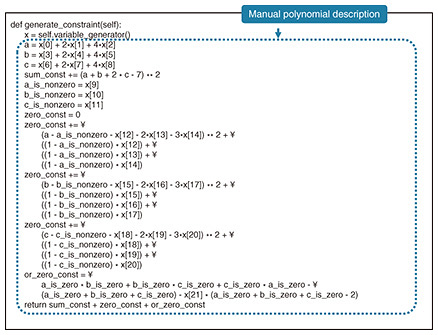
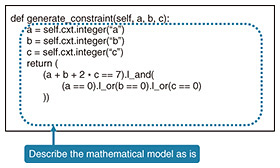
2. SDK supporting user problem description and executionThere are two major issues to address when considering the practical use of quantum computers, including optical quantum computers, especially for solving real social problems or applying them in business. One is that users need knowledge of quantum algorithms to input the problems they want to solve into a quantum computer. The other is that users need knowledge on the performance of quantum computers and algorithms to achieve performance beyond that of classical computers, which is one of the advantages of quantum computers. Both types of knowledge require advanced expertise in quantum computing and take time to acquire, making them a major barrier to enabling many people to casually benefit from quantum computers in many situations. To address these issues, NTT Computer and Data Science Laboratories is developing an SDK for quantum computers that can be used without specialized quantum knowledge. This SDK complements the aforementioned SDK for describing quantum algorithms as quantum circuits. It is specialized for the quantum-algorithm domain and targets areas such as quantum-based machine learning and optimization problems. We use the quantum approximate optimization algorithm (QAOA) [1], a quantum algorithm capable of solving combinatorial optimization problems, as an example to explain the issues addressed with this SDK. Although QAOA is an algorithm for qubits, qubit-oriented algorithms can also be executed on quantum circuits on the basis of quantum modes by using encoding methods such as the GKP code [2]. QAOA is considered an effective algorithm even on quantum computers that include a certain amount of noise, and early practical use is expected. A combinatorial optimization problem solved with QAOA is a problem of finding the best answer among many combinations of possible answers that satisfy given constraints. For example, the traveling salesman problem [3] treats travel routes through multiple cities as combinations of answers and asks for the route with the smallest cost, such as distance or time, under the constraint that all cities are visited exactly once and the route returns to the starting point. It is applied, for example, to logistics optimization. Therefore, combinatorial optimization is a broadly applicable concept that appears in many areas of society. Solving such combinatorial optimization problems using QAOA requires problem inputs tailored to the quantum algorithm and parameter tuning to achieve optimal performance. To input a problem into QAOA, it is necessary to associate each candidate solution with a quantum state and construct a Hamiltonian in which the evaluation value is represented as energy. Users must consider how to map the content of the answer to each qubit and design a Hamiltonian that can be efficiently embedded in an actual quantum circuit so that good answers satisfying the constraints correspond to the lowest quantum-energy states. The Hamiltonian must also be redesigned for each problem. To achieve optimal performance with QAOA, parameters that control changes in quantum-energy states must be set appropriately. As the target problem becomes larger, the number of such parameters increases, and their content also differs depending on the problem. For small problems, it may be possible to try all combinations of parameters, but in practical settings this would take too long and is not realistic. Efficient parameter tuning that reflects tendencies suitable for each problem is therefore required. The SDK developed by NTT solves these issues and provides functions that enable users to make full use of quantum computers even without specialized knowledge. There are several ways to input a Hamiltonian for QAOA. We compare input using a conventional quadratic unconstrained binary optimization (QUBO)*7 polynomial with input using NTT’s SDK. As a simple example, we consider a constraint involving integers a, b, and c. Input using the conventional method (Fig. 2) is relatively complicated, and users must consider formulas for each qubit. In contrast, input using NTT’s SDK (Fig. 3) enables the logical expression of the constraint to be described almost as is, intuitively, without considering the details of the qubits. For parameter tuning, the SDK also implements an automatic tuning function and provides efficient parameter tuning incorporating NTT’s proprietary expertise.
The SDK developed by NTT is thus planned to provide a way to quickly start using quantum computers without specialized knowledge. It will also provide functions that enable users to specify the details of quantum computers step by step. By serving a wide range of users, from those newly interested in quantum computers to those pursuing deeper research and business applications, this SDK will act as a bridge toward the practical use of quantum computers.
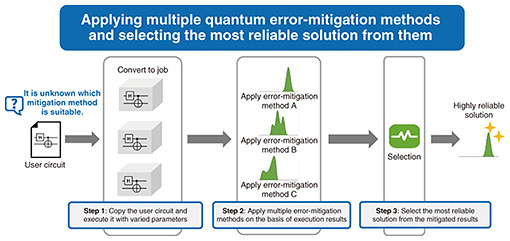
3. System software supporting efficient and highly reliable executionThis section introduces system software from two perspectives: efficient execution through coordination of quantum and classical computing resources and reliable execution through countermeasures against errors in quantum computation. When a quantum computer is used as a computing platform shared by multiple users, the execution platform is required to accept jobs, determine execution order, allocate quantum and classical computing resources, and monitor execution status. In particular, quantum computation involves a continuous sequence of preprocessing on classical computers, execution on a quantum computer, collection of measurement results, and postprocessing on classical computers. It is therefore important to develop a system architecture that enables the quantum computer to operate not as a standalone experimental device but as part of a computing service in coordination with classical computers and control software. In quantum-classical hybrid computation, represented by the variational quantum eigensolver and QAOA, the results obtained from the quantum computer are evaluated with a classical computer, and the conditions for the next quantum computation are updated on the basis of that evaluation. In this type of computation, the efficiency of the overall computation depends not only on the performance of the quantum computer but also on the efficient coordination of quantum and classical processing, including execution control, result evaluation, and repeated quantum executions. For today’s quantum computers, countermeasures against the effects of noise on computation results are indispensable. As noted above, quantum error mitigation reduces the impact of noise by using additional executions and postprocessing on classical computers. However, to actually use error mitigation, it is not enough simply to prepare a postprocessing algorithm. Additional executions corresponding to the error-mitigation method, management of multiple executions, collection of measurement results, and evaluation of results after error mitigation must be executed in coordination with the execution platform. Therefore, quantum error mitigation should be supported not only as a postprocessing algorithm but also as part of the execution workflow managed by the execution platform. NTT Computer and Data Science Laboratories is conducting research and development on software and system architectures that support the coordination of quantum and classical computers, safe and efficient sharing by multiple users, and noise countermeasures, with the aim of developing optical quantum computers as computing platforms usable by many users. As one result of this research and development related to noise countermeasures, we introduce an approach to quantum error mitigation for improving the reliability of quantum computation. Various quantum-error-mitigation methods have been proposed, but it is not easy to determine in advance which method will be effective for the quantum program that a user wants to run. Therefore, as shown in Fig. 4, this approach incorporates the idea of N-version programming from software engineering, which improves reliability by comparing multiple independent implementations. It evaluates the consistency of multiple error-mitigation results for probability distributions obtained from a quantum computer. By using the characteristics of the execution results, we developed a data-driven method for selecting results considered to be highly reliable. Because this is a postprocessing method that analyzes and evaluates obtained execution results on a classical computer rather than significantly modifying quantum hardware, it is expected to serve as a practical noise countermeasure for the early use of quantum computers [4].
In this research and development, we are studying software platforms that work in coordination with classical computers and technologies that improve the reliability of computation results, with the aim of making optical quantum computers available as practical computing services. 4. Future outlookThis article introduced an SDK that supports the use of optical quantum computers by users without specialized knowledge, as well as system software that coordinates quantum and classical computing resources and improves reliability. NTT Computer and Data Science Laboratories will continue expanding the target problem domains and quantum algorithms, further strengthening coordination with optical quantum hardware, and advancing evaluations using real machines and verification of use cases. By conducting integrated research and development from the SDK through the execution platform and reliability-enhancement technologies, we also aim to develop a computing platform that enables many users to use optical quantum computers easily and with confidence. Through these efforts, we will contribute to the early practical use of optical quantum computers and the creation of new social and business value. References
|
||||||||||||||||||||||||