|
|||||||||||||||||||||||||
|
|
|||||||||||||||||||||||||
        |
Feature Articles: Pioneering Optical Quantum Computers through Optical Communication Technologies Connecting Quantum Computers: How Quantum Communication Will Transform Computing ArchitectureAbstractResearch on quantum computers tends to focus on the performance of individual machines, such as the number of qubits and gate fidelity. As quantum computers approach the scale required for real business and social applications, however, adding qubits to a single device runs into practical limits in wiring, cooling, control, and manufacturing yield. The next competitive frontier is an architecture that links multiple quantum processors through quantum entanglement and operates them as one computer. Achieving this depends on a chain of quantum communication technologies for creating, delivering, storing, and using entanglement. This article presents quantum communication as the foundation for scaling out quantum computers and outlines the key technologies for modular quantum computing. Keywords: quantum communication, quantum entanglement, distributed quantum computing
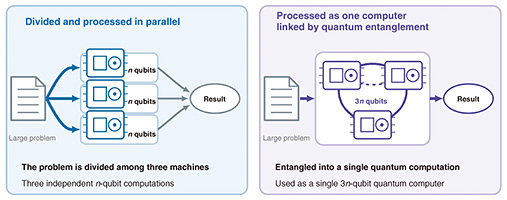
1. The need to connect quantum computersIn the history of classical computing, performance gains did not come from within single machines alone. Once computers were interconnected and put to work as clouds and datacenters, they grew into the large-scale information infrastructure that supports today’s society. Quantum computing is expected to follow a similar path. Increasing the qubit count and gate accuracy of a single machine remains a central research challenge, but the larger computations of the future will depend on how well multiple quantum processors can be connected. Scaling up a quantum computer is often equated with adding qubits to a single device. Yet no single chip, apparatus, or control system can accommodate an unlimited number of qubits or optical modes. Device size, wiring, cooling, control electronics, and manufacturing yield each impose a limit at some point. This holds for superconducting, trapped-ion, and optical quantum computers alike. A promising alternative is a modular architecture: several small quantum processors connected and operated as one large computer. This approach, also called distributed quantum computing, has become an important design principle for developing large-scale quantum computers. In classical computing, a large problem can be divided into subproblems and assigned to separate machines, extending the available computing power. Quantum processors can be parallelized in the same way if each is used as an independent machine. However, this merely runs separate quantum computations at the same time; it does not make any single quantum computation larger. The essence of connecting quantum computers lies in sharing quantum entanglement*1 between distant quantum processors and using it to execute quantum operations. In the quantum world, information resides not only in the state of each individual system but in the relationships between systems. Once entanglement is created, spatially separated quantum systems are no longer a mere collection of individual states; they form a single quantum state that cannot be separated into parts. This property should enable multiple quantum processors to serve as one large quantum computer. Consider three processors, each holding n qubits. Without shared entanglement, they are simply three independent quantum computers. With entanglement shared between the processors, nonlocal quantum states and operations spanning the processors become possible, and the whole system can ideally be used as a single quantum computer with 3n qubits [1] (Fig. 1). The quantum degrees of freedom available for computation then grow exponentially, from 2n for one processor to 23n for the whole system. Actual performance depends on the rate and fidelity of entanglement generation, memory time, and control synchronization, but this is where the value of connecting quantum computers lies.
The same pattern has already appeared in classical computing. In computing infrastructure for artificial intelligence (AI), performance is set not only by the capability of each processor but by the high-speed interconnects linking large numbers of graphics processing units. We expect quantum computing, too, to enter an era in which performance is governed by the technology of connection.
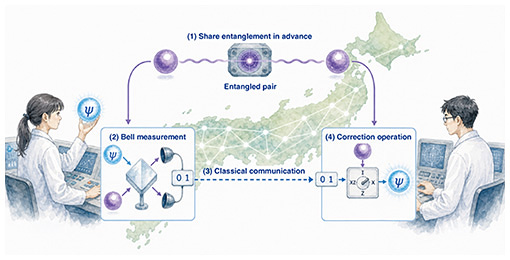
2. What quantum communication carriesThe role of quantum communication becomes clearer by contrast with classical communication. Classical communication delivers information expressed as 0s and 1s in the form of signals. In telephony and the Internet, electrical or optical signals travel along a transmission line, and the receiver reads them. A weakened signal can be regenerated with amplifiers; when necessary, it can be copied and distributed to multiple destinations. Quantum communication handles more than signals. It deals with the states of qubits and with the entanglement formed between distant quantum systems, that is, the “relationships” between them. To operate quantum computers as one large machine, this entanglement resource must be shared between distant quantum processors. Quantum communication is the set of technologies that creates, delivers, and stores entanglement so that it is available the moment it is needed. Quantum states, however, cannot be handled like classical information. An unknown quantum state cannot be copied perfectly, a principle known as the no-cloning theorem*2. Nor can a state lost in the channel be restored by amplification at a repeater along the way. When a photon traveling through an optical fiber is lost, the quantum information it carried is lost with it. Quantum communication therefore requires mechanisms for handing over quantum states as quantum states. A representative example is quantum teleportation. Combining pre-shared entanglement with classical communication, teleportation reproduces an unknown quantum state in the receiver’s quantum system without physically transporting the carrier of the qubit [2] (Fig. 2). Classical communication of the measurement results alone cannot reproduce the state; the shared entanglement is the essential resource that makes the transfer possible.
Light plays a central role. The photon, the smallest unit of light viewed as a quantum, carries quantum information in degrees of freedom such as polarization, time bin, and phase. Because photons interact only weakly with their surroundings, they carry quantum states largely intact. That property matters for long-distance links and equally for handling many short-distance connections at high speed. Photons are thus regarded as promising “flying qubits” for linking quantum processors. This advantage has a corresponding drawback. Photons pass through one another with little interaction, so the interactions required to create entanglement or swap it between systems are difficult to induce deliberately. Much of the technical difficulty of quantum communication stems from this property. The next section describes the technologies needed to generate and share entanglement stably.
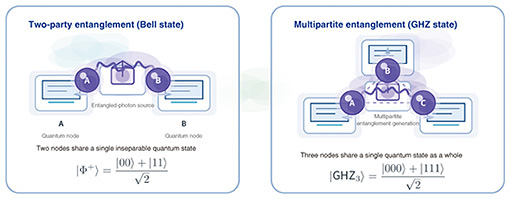
3. Key technologies supporting quantum networksFor a modular quantum computer to work as a single machine, entanglement must be shared reliably between distant quantum processors. This calls for a chain of operations: generating quantum states, delivering them where they are needed, holding them until they are needed, and putting them to use in computation and communication. These operations are not executed once, in sequence. In a real quantum network, entanglement generation will constantly be succeeding on one link while still pending on another. States obtained early must be held in quantum memory while generation is repeated elsewhere then joined into a network-wide state at the right moment. Quantum communication is thus also a systems technology for managing and supplying asynchronous quantum resources across an entire network. 3.1 Creating entanglementThe basic resource of quantum communication is entanglement shared between two parties. Creating it amounts to establishing a quantum mechanical correlation between two distant quantum nodes. In future large-scale distributed quantum computing, this two-party state will be the starting point from which quantum states spanning many nodes are assembled step by step. Generation is not easy. It requires delicate operations at the single-photon level, so it tends to succeed only probabilistically, and a high generation rate is difficult to combine with high fidelity. The quality and speed at which entanglement resources can be supplied will determine the performance of future quantum networks and distributed quantum computing. Beyond two-party entanglement, we are also generating multipartite entanglement, specifically GHZ (Greenberger–Horne–Zeilinger) states, for more flexible network configurations [3] (Fig. 3). The three-party GHZ state is especially useful. Its basic structure links three qubits, which makes it a convenient building block for the graph states underlying measurement-based quantum computation*3, and connecting multiple GHZ states yields progressively more complex graph states. The same structure also serves to improve error tolerance and stabilize processing, making it a valuable quantum resource.
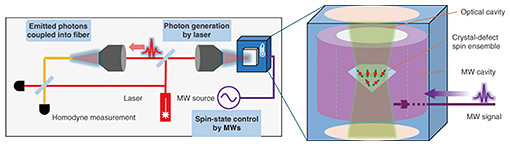
3.2 Delivering entanglementA quantum computer built from many modules cannot realistically connect every pair of processors with dedicated lines; in a fully connected configuration, the number of links grows with the square of the number of nodes. What is needed instead is a mechanism that connects the right quantum nodes at the right time and shares entanglement resources flexibly. In the classical Internet, switches and routers read, copy, and amplify signals while dynamically selecting routes to deliver information to its destination. A quantum network can do none of this. Observation changes a quantum state along the way, and an unknown state can be neither copied nor amplified. Routes must be switched without “looking at” the quantum states, and photons lost in transit cannot be replaced. Quantum networks therefore require networking technologies of their own, handling quantum states without destroying them at every stage: generation, storage, conversion, and relaying. The ability to switch connections dynamically through optical switching and routing would carry real weight. Dedicated optics and wiring would no longer be needed between every pair of modules, minimizing the overall equipment footprint of the quantum computer, and limited entanglement-generation resources could be allocated only where and when they are needed. The first step is sharing entanglement between nearby nodes at high speed and high fidelity. Rapid generation and sharing between chips, between racks, and within a datacenter would let quantum operations span modules efficiently, opening the way to larger machines. Optical quantum computers, which compute with light in the first place, are inherently well suited to networking; even so, building large cluster states efficiently raises the question of how best to interconnect the quantum processors. 3.3 Storing entanglementA quantum network requires more than light, the flying qubit; it also requires quantum memory to hold quantum states until they are called for. Entanglement generation with single photons, as used in communication, succeeds only probabilistically in most cases. Unless a state obtained early on one link can be stored, it cannot wait for the other links to succeed and be joined into a network-wide state. Quantum memory lets asynchronously generated resources wait until the moment they can serve computation or relaying. Light carries quantum states over distance well but holds them in place poorly. The key is a quantum interface that transfers the quantum state of light into a matter system, such as spins or atomic ensembles, and back into light when needed. This is no mere converter; it is the junction that lets different quantum systems behave as one network. We are studying quantum interfaces that connect quantum systems using ensembles of nitrogen-vacancy (NV) center*4 spins in diamond (Fig. 4). Given high-fidelity writing and readout, and sufficient coherence*5 (the time over which a quantum state is preserved) on the matter side, such an interface can serve not only as quantum memory but as a quantum transducer between quantum computers of different types. For NV-center spin ensembles, the path to practical network components runs through suppressing the frequency variations caused by local magnetic fields and strain and protecting the collective quantum state.
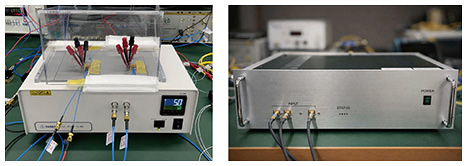
3.4 Using entanglementEntanglement generates no value merely by being created and distributed. Communication and computation arise when the resource is processed appropriately, and the central operation in that processing is quantum measurement. To classical intuition, measurement reads out a result. In quantum information, it does more: measurement transforms entanglement and drives communication and computation forward. In quantum teleportation, a Bell measurement transfers the quantum state; in measurement-based quantum computation, computation proceeds through repeated measurements. Such processing rests on highly efficient photon detectors and precise time measurement. Sharing entanglement at high speed, in particular, demands that the arrival time of each photon be captured precisely and each successful event identified reliably. We are developing photon-detection technology based on single-photon avalanche diode (SPAD)*6 devices, which operate at high speed at room temperature, together with time-measurement technology that handles on the order of 100 million detection events per second with picosecond precision [4] (Fig. 5).
4. How quantum communication will change computersQuantum communication, as this article has described, is the foundation on which a modular quantum computer operates as a single machine. Short-range connections in particular, between chips, between racks, and within a datacenter, are indispensable to scaling up quantum computers; as long as the goal of developing quantum computers stands, the need for them will not waver. Future quantum computers will evolve toward architectures that generate, share, and use entanglement as a resource across an entire network. The value of linking quantum computers across long distances, such as between cities, has yet to be established, though early indications are appearing. Blind quantum computation*7 has been proposed, in which processing is delegated over quantum communication to a remote quantum computer while the computation remains confidential. Further ahead, new forms of quantum AI may emerge that exchange quantum information over networks. Long-distance quantum networks are still developing in terms of their value, and their course will be set as such applications mature. The technologies for creating, delivering, storing, and using entanglement draw deeply on expertise built up in optical communication, optical networking, and optical measurement. Quantum communication is not an entirely new field; it is a research domain on the direct extension of the optical technologies NTT has accumulated over the years. Nor is it a communication channel placed outside the quantum computer; it is the architectural technology that supports the very structure of future quantum computers. Its maturation will underpin the scaling of computers and, beyond that, determine the shape of the future quantum information infrastructure.
References
|
||||||||||||||||||||||||